Types of Fades: Guide to Popular Fade Haircuts for Men
Introduction
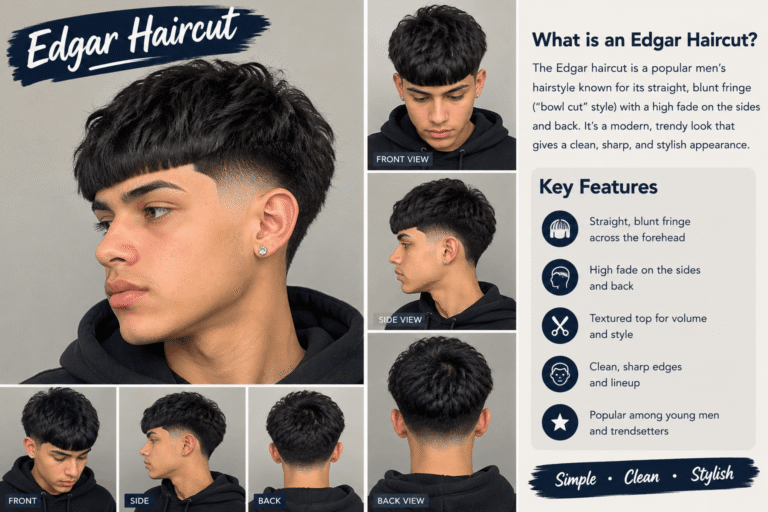
Fade haircuts are among the most popular men’s hairstyles because they offer a clean, modern appearance that works with many hair lengths, textures, and personal styles. A fade gradually blends the hair on the sides and back from longer strands near the top to very short hair or bare skin near the bottom. This smooth transition creates a sharp finish without limiting the styling options for the hair on top.
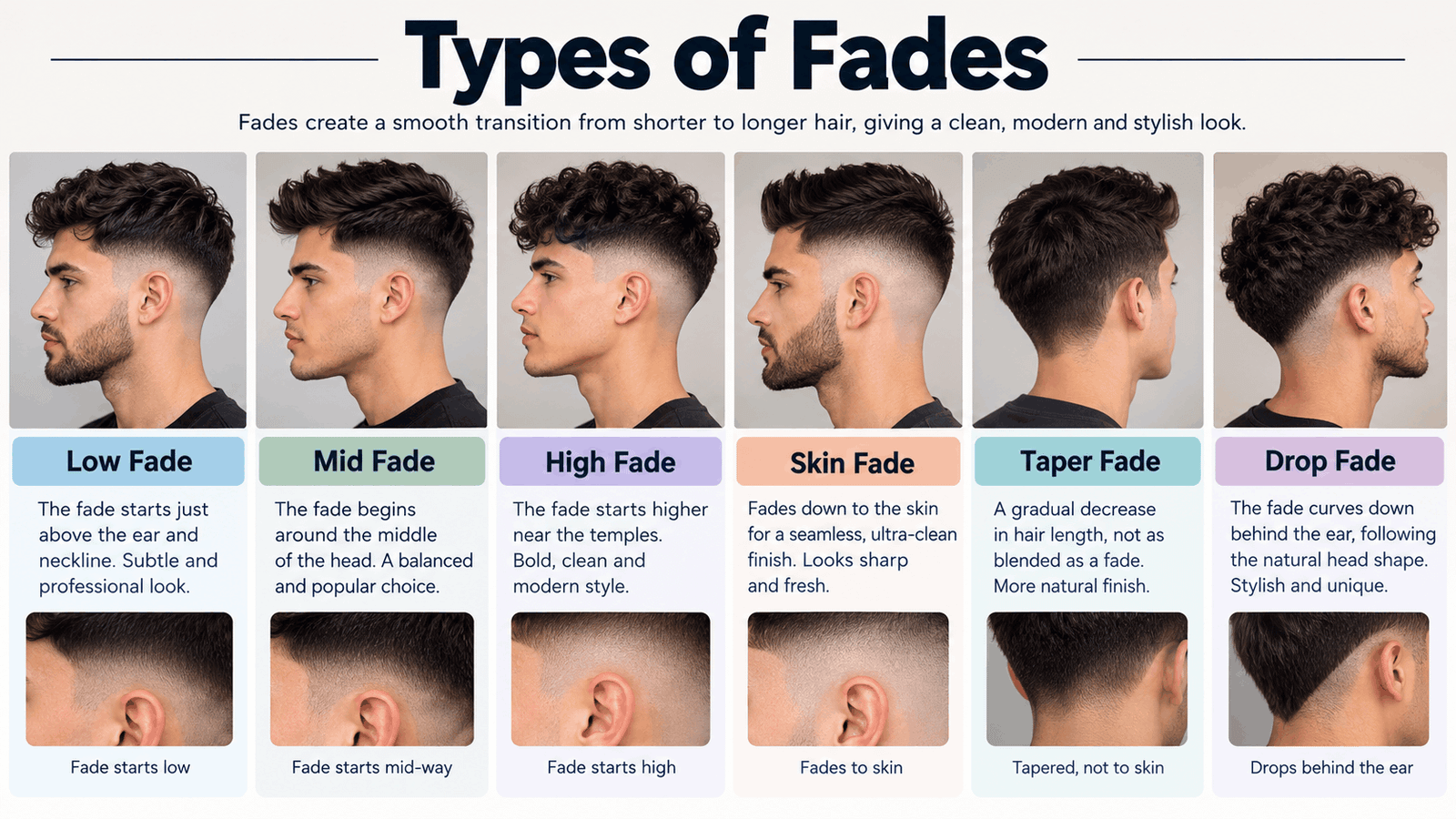
There are several types of fades, including low fades, mid fades, high fades, skin fades, taper fades, burst fades, and drop fades. Each creates a different shape and level of contrast. Some look subtle and professional, while others offer a bold, edgy appearance.
Choosing the right fade depends on your face shape, hair texture, preferred hairstyle, maintenance routine, and the amount of contrast you want. This guide explains the most popular options and how to choose the best one for your look.
What Is a Fade Haircut?
A fade haircut is a barbering technique in which the hair gradually transitions from one length to another, usually becoming shorter toward the neckline and around the ears. Clippers with different guards, blending techniques, and sometimes a straight razor are used to create a seamless finish.
Unlike a simple short haircut, a fade focuses on the transition between lengths. The fade can begin low near the ears, in the middle of the sides, or high toward the temples.
Fades can be paired with many hairstyles, including textured crops, pompadours, quiffs, curls, waves, buzz cuts, and longer swept-back styles.
1. Low Fade
The low fade begins just above the ears and follows the lower hairline around the back of the head. Most of the hair on the sides remains longer, creating a subtle and balanced appearance.
<AsyncImage query=”men low fade haircut textured top clean professional barber haircut side view” aspectRatio=”5:4″ width=”100%” />
Best for: Men who prefer a neat, understated hairstyle.
A low fade works particularly well with side parts, comb-overs, short textured tops, and curly hair. It is also a practical choice for workplaces that favor a more conservative appearance.
Because the fade starts low, it preserves more fullness around the temples and sides of the head.
2. Mid Fade
The mid fade starts around the middle of the sides, between the temples and the ears. It offers a balance between the subtle look of a low fade and the stronger contrast of a high fade.
<AsyncImage query=”men mid fade haircut modern textured quiff side profile professional barber” aspectRatio=”5:4″ width=”100%” />
Best for: Men who want a versatile, modern haircut.
This style pairs well with textured crops, short pompadours, quiffs, curly tops, and messy hairstyles. It provides enough contrast to make the haircut noticeable without removing too much hair from the sides.
A mid fade is a good starting point if you are unsure which fade height suits you.
3. High Fade
A high fade begins higher on the head, often around the temples or upper sides. The hair becomes short quickly, creating a strong contrast between the top and sides.
<AsyncImage query=”men high fade haircut thick textured hair top sharp clean side view barber style” aspectRatio=”5:4″ width=”100%” />
Best for: Men who prefer bold, sharp hairstyles.
High fades look especially effective with buzz cuts, French crops, textured tops, faux hawks, and short curly hairstyles. They can also make thick hair easier to manage by removing substantial bulk from the sides.
Because the fade rises higher, it exposes more of the head’s shape than a low fade does.
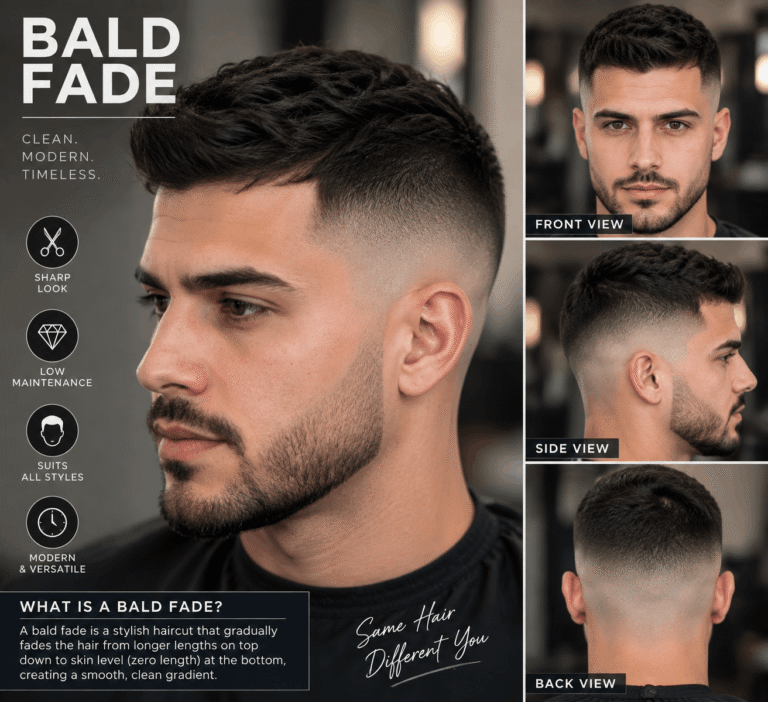
4. Skin Fade or Bald Fade
A skin fade gradually blends the hair down to bare skin at the lowest part of the haircut. The transition can begin low, in the middle, or high, so a skin fade describes the finishing technique rather than one specific height.
<AsyncImage query=”men bald skin fade haircut smooth shaved sides textured hair top close up barber finish” aspectRatio=”5:4″ width=”100%” />
Best for: Men who want a crisp, high-contrast finish.
Skin fades work with short crops, slicked-back hair, pompadours, curls, and buzz cuts. They can create a particularly clean look around the ears and neckline.
The very short finish makes regrowth more noticeable, so frequent barber visits may be needed to maintain the sharp appearance.
5. Taper Fade
A taper fade gradually shortens the hair around the sideburns and neckline while leaving more length on the sides than many traditional fades. The exact meaning varies between barbers, so it helps to show a reference photo.
<AsyncImage query=”men taper fade haircut natural neckline sideburns textured medium length top stylish clean haircut” aspectRatio=”5:4″ width=”100%” />
Best for: Men who want a polished haircut without an aggressively short finish.
Tapered styles pair well with side parts, curls, waves, natural textures, and professional hairstyles. They can look neat while preserving a fuller silhouette.
A traditional taper and a taper fade are related but not always identical: a taper usually refers to shortening around specific edges, while a fade may blend across a larger area of the sides and back.
6. Drop Fade
A drop fade curves downward behind the ear, following the natural shape of the head toward the back. Instead of maintaining a straight horizontal line, the fade drops lower at the rear.
<AsyncImage query=”men drop fade haircut curved fade behind ear textured curly top back side angle” aspectRatio=”5:4″ width=”100%” />
Best for: Men who want a shaped, distinctive profile.
Drop fades complement curly tops, textured crops, faux hawks, and modern short hairstyles. The curved transition can help emphasize the shape of the haircut and create a natural outline around the back of the head.
The final effect depends on how low the curve sits and how much length is left on top.
7. Burst Fade
A burst fade creates a semicircular blend around the ear. The hair becomes shorter in a rounded pattern while more length can remain at the back of the head.
<AsyncImage query=”men burst fade haircut rounded semicircle around ear curly mohawk modern barber style side view” aspectRatio=”5:4″ width=”100%” />
Best for: Men who want a creative, modern hairstyle.
Burst fades are commonly combined with mohawks, faux hawks, curly tops, textured crops, and mullets. The rounded shape around the ear gives the haircut its signature appearance.
For a dramatic result, some people pair a burst fade with longer hair at the back. For a more restrained look, the top and back can be kept relatively short.
8. Temple Fade
Also called a temp fade, this haircut focuses on blending the hair around the temples and sideburns. The rest of the sides and back can remain longer.
Best for: Men who want a defined hairline with minimal changes to the sides.
Temple fades work particularly well with curls, waves, short afros, and textured hair. They can create a clean outline around the forehead without requiring a full fade around the entire head.
A temple fade can also be combined with a low, mid, or high fade.
9. Shadow Fade
A shadow fade creates a soft, shaded transition without necessarily taking the hair down to bare skin. The hair gradually becomes shorter while retaining some visible darkness near the bottom.
<AsyncImage query=”men shadow fade haircut soft dark blended sides textured medium top natural finish barber” aspectRatio=”5:4″ width=”100%” />
Best for: Men who prefer a natural, softer finish.
Shadow fades work well with classic side parts, textured crops, short curls, and medium-length tops. They can look less dramatic than a skin fade while still providing a clean outline.
The barber may create a shadow effect with different clipper guards and blending techniques.
10. High Top Fade
A high top fade combines closely faded sides with a noticeably taller section of hair on top. The top may be shaped into a flat top, rounded afro, or another structured style.
<AsyncImage query=”men high top fade haircut tall natural afro top clean tapered faded sides contemporary barber portrait” aspectRatio=”5:4″ width=”100%” />
Best for: Men who want height, structure, and a distinctive silhouette.
This haircut is especially suited to tightly coiled and naturally textured hair, although the final shape can vary according to hair type and styling preferences.
Regular shaping helps maintain the height and clean lines of the top.
11. Burst Fade Mullet
A burst fade mullet combines the rounded fade around the ears with longer hair at the back. The top may be textured, curly, wavy, or styled into a short faux hawk.
<AsyncImage query=”modern men burst fade mullet haircut textured curly top longer back stylish side profile” aspectRatio=”5:4″ width=”100%” />
Best for: Men who enjoy fashion-forward hairstyles.
This haircut creates a strong contrast between the short sides and longer back. It can look sporty, alternative, or edgy depending on the length and texture.
Before choosing this style, consider whether you are comfortable maintaining both the faded sides and the longer back section.
12. Low Skin Fade
A low skin fade combines a low fade position with a shaved finish near the bottom. The transition begins close to the ears and neckline, keeping most of the sides fuller.
Best for: Men who want a clean finish without a high fade.
This style pairs well with short textured tops, side parts, waves, and curly hairstyles. It creates a crisp outline while keeping the overall shape relatively conservative.
The shaved area may need regular touch-ups because even a small amount of regrowth can soften the contrast.
13. Mid Skin Fade
A mid skin fade begins around the middle of the sides and blends down to bare skin. It offers more contrast than a low skin fade while avoiding the very high starting point of a high skin fade.
Best for: Men looking for a noticeable but balanced haircut.
It works with textured crops, quiffs, short curls, and brushed-up styles. The combination of a medium starting point and a skin finish makes it adaptable to both casual and modern fashion looks.
14. High Skin Fade
A high skin fade begins high on the sides and transitions down to bare skin. It creates one of the strongest contrasts available in fade haircuts.
Best for: Men who want a bold, sharp appearance.
It pairs well with buzz cuts, short textured tops, pompadours, and defined curls. Because the fade removes much of the hair from the sides, it places greater emphasis on the top and overall head shape.
15. Scissor Fade
A scissor fade uses scissors, often alongside clippers, to create a softer and more tailored transition. The term can vary between barbers, and it may describe a scissor-over-comb blend rather than a standardized fade category.
Best for: Men who want a customized finish with a more natural feel.
It can work well with medium-length hairstyles, classic cuts, and hair that benefits from retaining more texture on the sides. Discuss the desired length with your barber because the result depends on the technique used.
How to Choose the Best Fade for Your Face Shape
Face shape can help guide your decision, but hair texture, hairline, head shape, and personal preference matter just as much.
Round Face
A mid or high fade paired with some height on top can create a more elongated appearance. Textured quiffs and pompadours are popular options.
Oval Face
Oval faces tend to work well with many fade styles, including low, mid, high, and drop fades. Choose according to your preferred level of contrast and the hairstyle you want on top.
Square Face
A low or mid fade can complement a strong jawline while keeping the overall haircut balanced. Short textured styles and classic side parts are useful options.
Long or Oblong Face
A low or mid fade with moderate volume on top can help maintain balance. Extremely high fades combined with excessive height may make the face appear longer.
Heart-Shaped Face
A softer low fade or a balanced mid fade may work well with textured hair on top. Your barber can adjust the sides and fringe to complement the forehead and chin.
These are general styling suggestions rather than strict rules. A good barber can adapt the fade to your individual features.
Which Fade Works Best for Different Hair Types?
Straight Hair
Straight hair works well with low, mid, high, and skin fades. Textured crops, side parts, slicked-back styles, and quiffs can add movement and structure.
Curly Hair
Curly hair pairs particularly well with burst fades, drop fades, temple fades, and mid fades. Keeping the curls longer on top creates contrast and allows the natural texture to stand out.
Wavy Hair
Wavy hair looks good with low fades, mid fades, and taper fades. These styles preserve enough length for the waves to remain visible while cleaning up the sides.
Thick Hair
High fades and mid fades can remove excess bulk from thick hair. A textured top can make the hairstyle easier to manage without making it look flat.
Thin Hair
A low fade, subtle taper, or carefully blended mid fade may help maintain a balanced appearance. Very short sides can create contrast, but the best choice depends on the amount and distribution of hair.
Coily or Afro-Textured Hair
Temple fades, high top fades, burst fades, and drop fades can complement natural texture. Regular line-ups and shaping may help preserve a clean finish.
How to Maintain a Fade Haircut
A fade usually looks sharpest when the transition remains clean and the neckline and sideburns are well maintained.
- Schedule regular trims: Many people refresh a short fade every two to four weeks, depending on how quickly their hair grows and how sharp they want it to look.
- Use suitable hair products: Choose a matte clay, lightweight cream, pomade, or curl product based on the style and texture of the top.
- Keep the scalp comfortable: Wash as needed and use a suitable moisturizer if the skin becomes dry.
- Avoid aggressive home trimming: Using clippers without the right guards or blending technique can leave visible lines.
- Maintain the top separately: Longer styles may need occasional shaping even when the sides still look acceptable.
Skin fades generally show regrowth sooner than shadow fades or longer tapers.
How to Explain Your Preferred Fade to a Barber
Clear communication helps you get the result you want. Rather than simply asking for a fade, specify a few details:
- Fade height: Low, mid, or high.
- Bottom finish: Skin, very short stubble, or a softer shadow.
- Shape: Straight, rounded, or dropped behind the ears.
- Top length: Short, medium, long, curly, or textured.
- Hairline: Natural or sharply lined up.
Showing a reference photo from the side and back can be especially helpful because two haircuts with the same name may look different.
If you are trying a fade for the first time, a low or mid fade is often a versatile starting point. You can choose a higher or more dramatic style at a later appointment if you prefer more contrast.
Conclusion
Fade haircuts offer many ways to personalize a men’s hairstyle, from subtle low fades and classic taper fades to bold high skin fades, drop fades, and burst fades. The main differences involve where the blend begins, how short the hair becomes, and the shape of the transition around the ears and back of the head.
The best option depends on your hair type, face shape, desired appearance, and maintenance routine. A low fade provides a restrained finish, a mid fade offers versatility, and a high fade creates stronger contrast. Specialty styles such as burst fades and drop fades add distinctive shapes.
For the best result, discuss your preferred fade height, bottom finish, and top length with your barber. A well-matched fade can make your hairstyle look cleaner, more balanced, and easier to style.
Frequently Asked Questions
1. What are the main types of fades?
The main types include low fade, mid fade, high fade, skin fade, taper fade, drop fade, burst fade, temple fade, and shadow fade. Each differs in height, shape, or how short the hair becomes.
2. Which fade haircut is the most popular?
Low, mid, and high fades are widely requested because they work with many hairstyles. The best choice depends on personal preference, hair texture, and the desired level of contrast.
3. What is the difference between a low fade and a high fade?
A low fade starts close to the ears and neckline, leaving more hair on the sides. A high fade begins higher on the head and creates a stronger contrast between the top and sides.
4. Is a taper fade the same as a regular fade?
Not exactly. A taper generally focuses on gradually shortening the hair around the sideburns and neckline, while a regular fade may blend the sides and back over a larger area. Barber terminology can vary.
5. What is a skin fade?
A skin fade blends the hair down to bare skin near the bottom. It can be combined with a low, mid, or high fade depending on where the transition begins.
6. Which fade is best for curly hair?
Burst fades, drop fades, temple fades, and mid fades can all work well with curly hair. The right choice depends on how much volume you want to keep on top and around the back.
7. How often should I get a fade haircut?
Many people get a fade refreshed every two to four weeks. Skin fades may require more frequent maintenance because regrowth becomes noticeable quickly.
8. Which fade is best for a professional look?
A low fade or subtle taper fade is often suitable for professional settings. A neatly blended mid fade can also work well when the overall haircut is appropriate for the workplace.
9. What is the difference between a drop fade and a burst fade?
A drop fade curves downward behind the ear toward the back of the head. A burst fade creates a rounded, semicircular blend around the ear, often leaving more length at the back.
10. How do I choose the right fade for my face shape?
Consider your face shape, hair texture, hairline, and desired style together. Low and mid fades are versatile starting points, while a skilled barber can adjust the height and shape to suit your features.