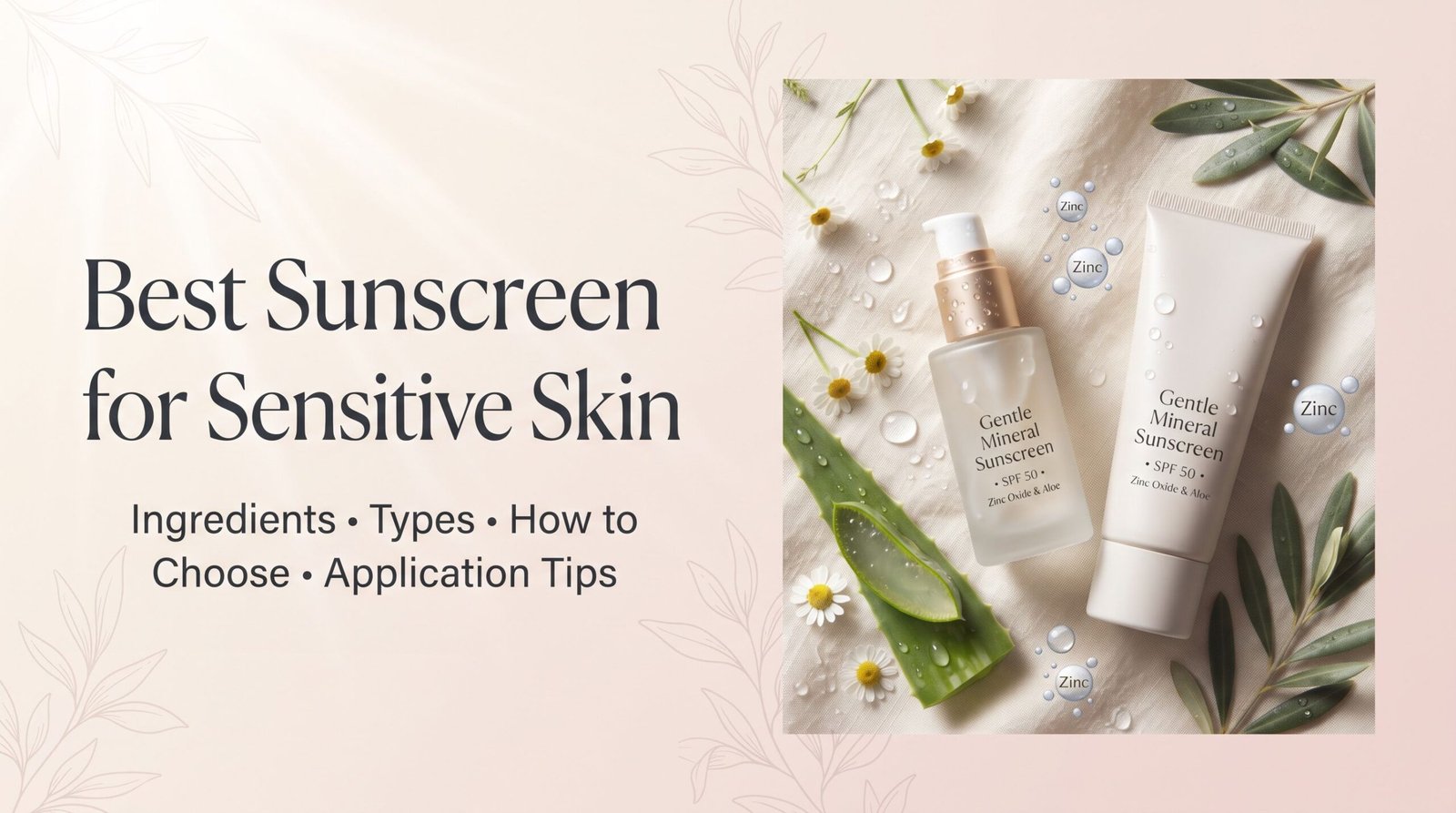
Best Sunscreen for Sensitive Skin: Ingredients, and Application Tips
Introduction
Finding the best sunscreen for sensitive skin can be challenging. Sunscreen is essential for protecting the skin from UV radiation, but some formulas may cause stinging, burning, redness, itching, or breakouts in people with easily irritated skin.
Sensitive skin usually benefits from a simple approach: choose a sunscreen that provides broad-spectrum protection, SPF 30 or higher, and water resistance, while also avoiding ingredients that commonly trigger irritation. The American Academy of Dermatology (AAD) specifically suggests that people with sensitive skin consider sunscreens labeled for sensitive skin and avoid fragrance and certain potentially irritating ingredients.
For people whose skin burns or stings when sunscreen is applied, the AAD recommends looking for a mineral sunscreen containing zinc oxide and/or titanium dioxide.
This guide explains how to choose sunscreen for sensitive skin, which ingredients to look for, what to avoid, mineral versus chemical sunscreen, options for acne-prone and dry skin, and how to apply sunscreen correctly.
What Is the Best Sunscreen for Sensitive Skin?
There isn’t one sunscreen that is perfect for everyone with sensitive skin. The best option depends on your skin type, concerns, climate, and how easily your skin reacts to products.
As a starting point, look for:
- SPF 30 or higher
- Broad-spectrum protection
- Water resistance
- Fragrance-free formulation
- Minimal potential irritants
- Non-comedogenic labeling if you’re acne-prone
- Zinc oxide and/or titanium dioxide if your skin frequently stings
The AAD’s three basic sunscreen requirements are SPF 30+, broad-spectrum protection, and water re
For very reactive skin, a fragrance-free mineral sunscreen is often a particularly useful place to start.
Why Is Sunscreen Important for Sensitive Skin?
Sensitive skin can become irritated more easily, but that doesn’t make sun protection less important.
UV exposure can contribute to:
- Sunburn
- Premature skin aging
- Wrinkles
- Dark spots
- Uneven pigmentation
- Skin cancer
Regular sunscreen use can help reduce these risks. The AAD recommends sunscreen as part of a broader sun-protection strategy that also includes shade, protective clothing, hats, and sunglasses.
For people prone to pigmentation, protecting the skin from sunlight can also be particularly important because UV exposure can worsen discoloration.
Mineral vs. Chemical Sunscreen for Sensitive Skin
One of the biggest questions when choosing sunscreen is whether to use a mineral or chemical formula.
Mineral Sunscreen
Mineral sunscreens use active ingredients such as:
- Zinc oxide
- Titanium dioxide
The AAD specifically recommends mineral sunscreens for people with sensitive skin.
They may be especially useful if your skin burns or stings when you apply sunscreen.
Advantages
- Often well tolerated by sensitive skin
- Useful for reactive or redness-prone skin
- Zinc oxide provides broad-spectrum protection
- Available in fragrance-free formulas
Possible Disadvantage
Some mineral sunscreens can leave a white cast, particularly on darker skin tones.
Tinted mineral formulas can help reduce this problem.
Chemical Sunscreen
Chemical sunscreens use UV filters that absorb UV radiation.
Some people with sensitive skin tolerate chemical sunscreens perfectly well. However, if your sunscreen consistently causes burning or stinging, a mineral formula may be worth trying.
The AAD notes that either mineral or chemical sunscreens can effectively protect the skin when they provide broad-spectrum SPF 30+ protection and water resistance.
Therefore, “chemical” does not automatically mean bad, and “mineral” does not automatically mean perfect for everyone.
Best Ingredients for Sensitive Skin
1. Zinc Oxide
Zinc oxide is one of the most useful sunscreen ingredients for sensitive skin.
The AAD recommends sunscreens containing zinc oxide and/or titanium dioxide for people whose skin stings or burns when sunscreen is applied.
Zinc oxide provides broad-spectrum UV protection and is commonly found in sunscreens formulated for sensitive skin.
2. Titanium Dioxide
Titanium dioxide is another mineral UV filter.
It can be used alone or together with zinc oxide.
People with highly reactive skin often find mineral formulas containing these ingredients easier to tolerate.
3. Ceramides
Ceramides help support the skin barrier and are commonly included in moisturizing sunscreen formulations.
They can be particularly appealing if your sensitive skin is also dry.
4. Glycerin
Glycerin is a humectant that helps attract and retain moisture.
A sunscreen containing glycerin may feel more comfortable if your skin tends to become dry or tight.
5. Niacinamide
Niacinamide is included in some sunscreen formulas because of its skincare benefits.
It may be useful for people concerned with uneven tone, redness, or barrier support.
However, even beneficial ingredients can irritate certain individuals, so personal tolerance remains important.
Ingredients to Avoid or Approach Carefully
Fragrance
Fragrance is one of the first ingredients to consider avoiding if you have sensitive skin.
The AAD recommends fragrance-free sunscreen for people with sensitive or allergy-prone skin. (American Academy of Dermatology)
Don’t confuse fragrance-free with “unscented.” A product can be unscented while still containing ingredients used to mask odors.
Oxybenzone
The AAD recommends that people with allergy-prone skin avoid oxybenzone and several related ingredients. (American Academy of Dermatology)
If your skin frequently develops reactions to sunscreen, choosing a mineral formula may simplify your routine.
Essential Oils
Lavender, citrus, peppermint, tea tree, and other essential oils can sound gentle because they’re plant-derived, but they may cause irritation or sensitization in some people.
For highly reactive skin, a fragrance-free formula without unnecessary essential oils may be preferable.
Alcohol
Some sunscreens contain alcohol to create a lightweight, fast-drying texture.
While many people tolerate these products, they can be uncomfortable for very dry or sensitive skin.
If your sunscreen consistently causes burning or dryness, consider a more moisturizing formula.
Best Sunscreen for Dry Sensitive Skin
If your skin is both dry and sensitive, look for a sunscreen with a moisturizing texture.
Useful features include:
- Cream or lotion consistency
- Fragrance-free formulation
- Glycerin
- Ceramides
- Hyaluronic acid
- Emollient ingredients
- Mineral filters if your skin is highly reactive
The AAD recommends moisturizing sunscreens for dry skin. (American Academy of Dermatology)
Avoid products that leave your skin feeling extremely tight after application.
Best Sunscreen for Oily Sensitive Skin
Sensitive skin can also be oily.
If you have oily or combination skin, consider a lightweight sunscreen labeled:
- Non-comedogenic
- Oil-free
- Lightweight
- Gel or fluid texture
The AAD recommends looking for “non-comedogenic” or “won’t clog pores” labeling if you have oily or acne-prone skin.
However, don’t choose a sunscreen solely because it feels matte. Some extremely mattifying formulas can be uncomfortable for sensitive skin.
Best Sunscreen for Acne-Prone Sensitive Skin
Acne-prone skin needs sun protection because UV exposure can worsen the appearance of post-acne marks and pigmentation.
Look for:
- SPF 30+
- Broad-spectrum protection
- Non-comedogenic formula
- Fragrance-free formulation
- Lightweight texture
A mineral sunscreen can be useful if your acne-prone skin is also highly reactive.
If you are using acne medications such as retinoids or exfoliating acids, your skin may become more sensitive, making gentle sun protection especially important.
Best Sunscreen for Rosacea-Prone Skin
Rosacea-prone skin can be particularly reactive.
The AAD recommends sunscreen containing only zinc oxide and titanium dioxide for people with rosacea. (American Academy of Dermatology)
A suitable routine may include:
- Gentle cleanser
- Moisturizer
- Mineral sunscreen
- Hat or other sun-protective clothing when outdoors
Choose fragrance-free products and avoid anything that consistently causes burning or flushing.
Best Sunscreen for Eczema-Prone Skin
Eczema-prone skin often has a compromised skin barrier.
For this type of skin, consider:
- Fragrance-free sunscreen
- Mineral UV filters
- Moisturizing ingredients
- Cream-based formulas
- Products designed for sensitive skin
Avoid applying sunscreen to actively cracked or severely irritated skin without discussing appropriate care with a healthcare professional.
If every sunscreen causes a rash, the issue may be contact dermatitis rather than simply “sensitive skin.”
Tinted Sunscreen for Sensitive Skin
Tinted sunscreen can be an excellent option for people who dislike the white cast associated with mineral sunscreen.
This is especially useful for darker skin tones.
The AAD notes that tinted sunscreens containing iron oxides can provide additional protection against visible light, which can contribute to skin darkening and hyperpigmentation. (American Academy of Dermatology)
A tinted sunscreen can therefore provide two practical benefits:
- Less visible white residue
- Additional protection against visible-light-related pigmentation
Choose a shade that blends comfortably with your skin tone.
Best Sunscreen for Sensitive Skin Under Makeup
If you wear makeup, look for a sunscreen that:
- Absorbs easily
- Doesn’t pill
- Has a lightweight texture
- Doesn’t leave excessive residue
- Is fragrance-free
- Works with your moisturizer and makeup
A fluid or lightweight lotion may work better under makeup than a thick mineral cream.
However, if your skin is extremely reactive, tolerability should come before cosmetic finish.
How Much Sunscreen Should You Apply?
Using the right sunscreen but applying too little can significantly reduce the protection you actually receive.
Apply sunscreen generously to all exposed skin.
For the face, neck, ears, and other exposed areas, use enough product to create an even protective layer.
Don’t forget commonly missed areas such as:
- Ears
- Neck
- Hairline
- Back of hands
- Tops of feet
- Lips
For the lips, use a lip balm with SPF 30 or higher and broad-spectrum protection. (American Academy of Dermatology)
When Should You Apply Sunscreen?
Apply sunscreen before going outdoors.
Give the product enough time to form an even layer according to the product instructions.
Sunscreen should be part of your morning skincare routine whenever you expect sun exposure.
It is particularly important when spending time:
- Outdoors
- At the beach
- Near water
- In snowy environments
- Driving for long periods
- Participating in outdoor sports
Remember that UV exposure can occur even when the weather doesn’t feel particularly hot.
How Often Should You Reapply Sunscreen?
When outdoors, the AAD recommends reapplying sunscreen approximately every two hours, and after swimming or sweating, according to the product’s directions.
Water-resistant sunscreen isn’t waterproof.
Water resistance generally lasts for either 40 or 80 minutes, depending on the product label.
If you’re swimming or exercising heavily, reapplication becomes particularly important.
Does SPF 50 Work Better Than SPF 30?
Both SPF 30 and SPF 50 can provide excellent protection when applied correctly.
The AAD recommends SPF 30 or higher.
The difference is not simply that SPF 50 is “twice as strong” as SPF 25. SPF numbers describe protection against sunburn-causing UVB radiation.
According to the AAD, SPF 30 filters approximately 97% of UVB radiation under test conditions.
For everyday use, choosing a sunscreen you can comfortably apply generously and reapply consistently is more important than obsessing over the highest SPF number available.
Can Sensitive Skin Use Sunscreen Every Day?
Yes.
Daily sunscreen use is one of the most important habits for protecting the skin from UV exposure.
The key is finding a formula that you can use consistently without irritation.
If one sunscreen causes burning or redness, don’t assume that you need to stop sunscreen altogether. Try a different formulation, especially a fragrance-free mineral sunscreen if appropriate.
How to Patch Test Sunscreen
If your skin frequently reacts to skincare products, testing a new sunscreen before applying it all over your face can be helpful.
Apply a small amount to a limited area and monitor the skin for signs of irritation.
Look for:
- Redness
- Itching
- Burning
- Swelling
- Rash
If you develop a significant reaction, wash the product off and discontinue use.
People with repeated product reactions may benefit from dermatologist evaluation and patch testing.
Why Does Sunscreen Burn Sensitive Skin?
Several factors can cause stinging.
Damaged Skin Barrier
If your skin is already dry, peeling, or irritated, sunscreen may sting more easily.
Certain UV Filters
Some people react more strongly to particular chemical sunscreen filters.
Fragrance
Fragrance can contribute to irritation or allergic reactions.
Alcohol
Alcohol-containing formulas may sting compromised skin.
Eye Area
Sunscreen migrating into the eyes can cause significant stinging even when the product isn’t otherwise irritating.
If sunscreen repeatedly burns your skin, the AAD recommends trying a mineral formula containing only zinc oxide and/or titanium dioxide and avoiding fragrance. (American Academy of Dermatology)
How to Apply Sunscreen Without Irritating Your Skin
A gentle application technique can make a noticeable difference.
Step 1: Start With Clean Skin
Use a mild cleanser.
Step 2: Moisturize if Necessary
If your skin is dry, apply a suitable moisturizer before sunscreen.
Step 3: Apply Sunscreen Gently
Don’t aggressively rub the product into the skin.
Step 4: Cover All Exposed Areas
Include your neck and ears.
Step 5: Reapply
Reapply approximately every two hours while outdoors and after swimming or sweating. (American Academy of Dermatology)
Is Mineral Sunscreen Better Than Chemical Sunscreen?
For sensitive skin, mineral sunscreen is often a useful first choice.
The AAD specifically recommends physical/mineral sunscreens containing zinc oxide or titanium dioxide for sensitive skin. (American Academy of Dermatology)
However, this doesn’t mean chemical sunscreens are unsafe or ineffective.
A chemical sunscreen that is fragrance-free, well tolerated, and provides adequate broad-spectrum protection may be an excellent option for an individual with sensitive skin.
The best sunscreen is ultimately one you can tolerate and use consistently.
What About “Natural” Sunscreen?
Natural does not automatically mean better for sensitive skin.
Some products marketed as natural may contain:
- Essential oils
- Botanical extracts
- Fragrance
- Other potentially irritating ingredients
Instead of relying on the word “natural,” read the ingredient list and look for the characteristics that actually matter:
SPF 30+, broad spectrum, water resistance, and good skin tolerance.
Examples of Sunscreens Commonly Considered for Sensitive Skin
If you’re comparing products, several categories are worth exploring.
Mineral Zinc Oxide Sunscreens
These are particularly useful for very reactive skin.
Tinted Mineral Sunscreens
These can help reduce the white cast and may provide additional visible-light protection.
Fragrance-Free Facial Sunscreens
Good options for people who want lightweight daily protection.
Moisturizing Mineral Sunscreens
Useful for dry sensitive skin.
Non-Comedogenic Sunscreens
Useful for sensitive, oily, or acne-prone skin.
Current expert roundups include products such as Vanicream Facial Moisturizer SPF 30, Eucerin Sun Sensitive Mineral SPF 50, Blue Lizard Sensitive Mineral SPF 50+, and various EltaMD formulas among options considered for sensitive skin. Individual tolerability still matters more than the brand name. (NBC News)
Common Sunscreen Mistakes to Avoid
Using Too Little
Insufficient sunscreen means insufficient protection.
Forgetting the Neck
The neck receives plenty of sun exposure but is frequently overlooked.
Applying Only on Sunny Days
UV exposure isn’t limited to hot, cloudless days.
Not Reapplying
One morning application may not protect you during a full day outdoors.
Rubbing Too Aggressively
Sensitive skin doesn’t need vigorous rubbing.
Ignoring the Label
Always check SPF, broad-spectrum status, water resistance, and active ingredients.
Sunscreen and Hyperpigmentation
People concerned about dark spots should take sun protection particularly seriously.
UV exposure can worsen pigmentation, and visible light can also contribute to darkening, particularly in people with darker skin tones.
The AAD recommends considering tinted sunscreen containing iron oxides when visible-light protection is a concern. (American Academy of Dermatology)
For people treating melasma or post-inflammatory hyperpigmentation, sunscreen should be part of a broader treatment plan rather than the only treatment.
When Should You See a Dermatologist?
If sunscreen consistently causes:
- Severe burning
- Persistent redness
- Swelling
- Blisters
- Itching
- Recurrent rash
consider seeing a dermatologist.
You may have an allergy to an ingredient or an underlying condition such as eczema, rosacea, or contact dermatitis.
A dermatologist can help identify the cause and recommend sunscreen ingredients that your skin is more likely to tolerate.
Final Thoughts
The best sunscreen for sensitive skin is one that provides reliable UV protection without triggering irritation. As a basic rule, choose SPF 30 or higher, broad-spectrum protection, and water resistance. (American Academy of Dermatology)
If your skin is particularly reactive, a fragrance-free mineral sunscreen containing zinc oxide and/or titanium dioxide is an excellent place to start. The AAD specifically recommends mineral sunscreen for sensitive skin and suggests avoiding fragrance and certain ingredients that may cause irritation. (American Academy of Dermatology)
Dry skin may benefit from a moisturizing cream or lotion, while oily and acne-prone skin may do better with a lightweight, non-comedogenic formula. If you’re concerned about pigmentation or white cast, a tinted sunscreen containing iron oxides can be especially useful.
Most importantly, sunscreen only works well when you use enough of it and reapply when necessary. When outdoors, reapply about every two hours and after swimming or sweating.
Sunscreen should also be combined with shade, protective clothing, a wide-brimmed hat, and sunglasses whenever possible.
FAQs About the Best Sunscreen for Sensitive Skin
1. What is the best sunscreen for sensitive skin?
A fragrance-free, broad-spectrum sunscreen with SPF 30 or higher is a good starting point. If your skin burns or stings with sunscreen, consider a mineral formula containing zinc oxide and/or titanium dioxide.
2. Is mineral sunscreen better for sensitive skin?
Mineral sunscreens are often recommended for sensitive skin because they use zinc oxide and/or titanium dioxide. The AAD specifically recommends mineral sunscreen for sensitive skin. (
3. Is SPF 30 enough for sensitive skin?
Yes. The AAD recommends SPF 30 or higher. SPF 30 provides approximately 97% protection against UVB under standardized testing conditions.
4. Should sensitive skin avoid fragrance in sunscreen?
Yes, fragrance-free sunscreen is generally a better choice for sensitive or allergy-prone skin. Fragrance can trigger irritation or allergic reactions in susceptible people.
5. What sunscreen is best for sensitive acne-prone skin?
Look for a lightweight, fragrance-free, non-comedogenic sunscreen with SPF 30 or higher. A mineral formula can be useful if your acne-prone skin is also highly reactive.
6. Is zinc oxide good for sensitive skin?
Yes. Zinc oxide is a mineral sunscreen ingredient commonly recommended for sensitive and reactive skin. It provides broad-spectrum UV protection.
7. Why does sunscreen burn my sensitive skin?
Burning can occur because of a damaged skin barrier, certain sunscreen filters, fragrance, alcohol, or individual sensitivity to an ingredient. If this happens repeatedly, try a fragrance-free mineral sunscreen.
8. Is tinted sunscreen better for sensitive skin?
Tinted sunscreen isn’t automatically gentler, but it can be useful if you want to minimize white cast. Tinted products containing iron oxides may also provide additional protection against visible light-related pigmentation. (American Academy of Dermatology)
9. How often should I reapply sunscreen?
When outdoors, the AAD recommends reapplying approximately every two hours and after swimming or sweating, following the product’s instructions.
10. When should I see a dermatologist about sunscreen irritation?
See a dermatologist if sunscreen repeatedly causes significant burning, itching, swelling, rash, or other persistent reactions. A dermatologist can help identify possible allergies or underlying skin conditions and recommend appropriate alternatives.