Conch Piercing: Pain, Healing, Jewelry & Complete Guide
Introduction
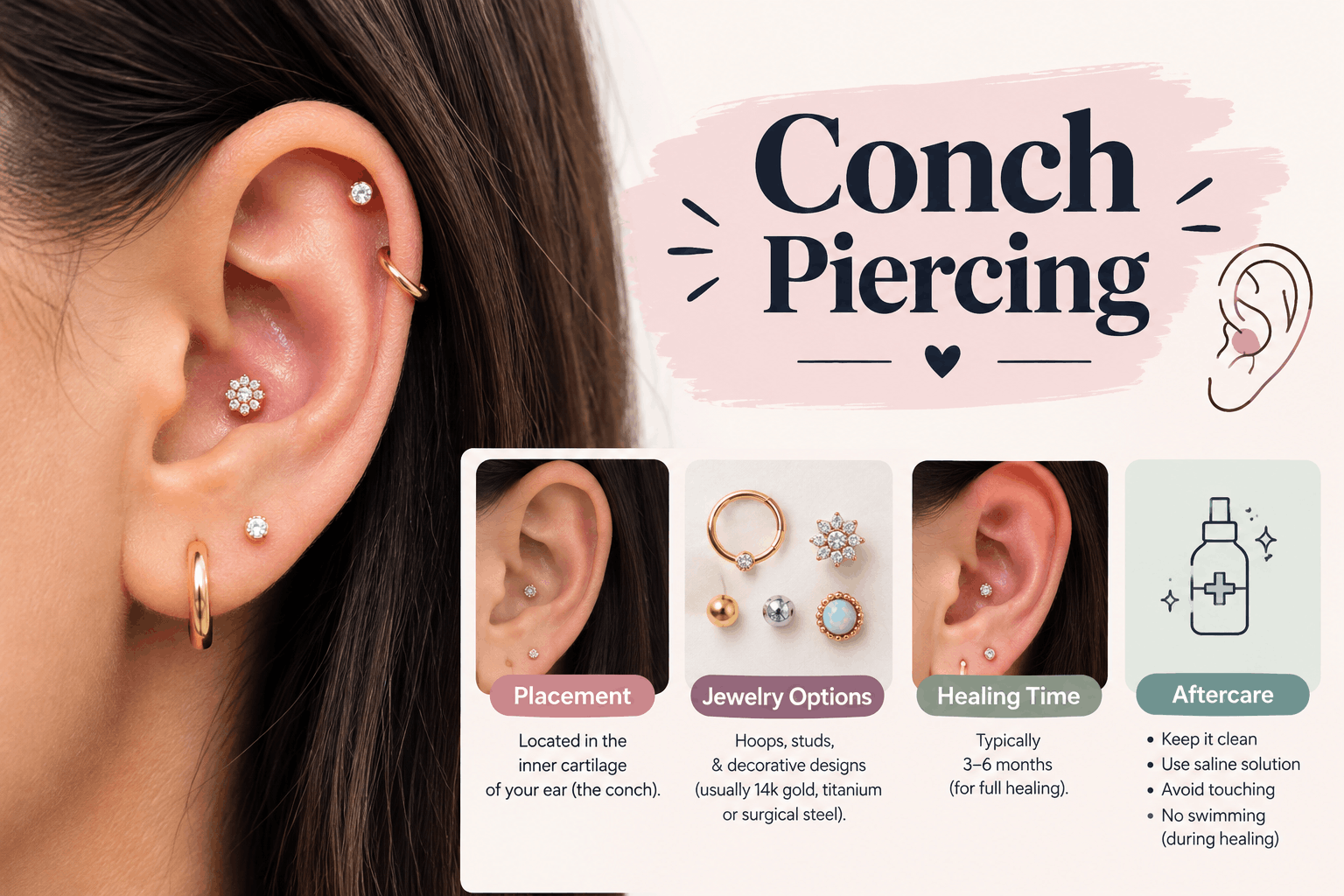
A conch piercing is one of the most stylish cartilage piercings for people who want a distinctive ear look without covering the entire ear with multiple pieces of jewelry. Positioned through the inner cartilage of the ear, a conch piercing can be decorated with a simple stud, gemstone, hoop, or carefully coordinated ear stack.
Unlike a standard earlobe piercing, however, the conch passes through cartilage. Cartilage has less blood supply than soft tissue, so it generally takes considerably longer to heal. Cleveland Clinic estimates that conch piercings can take approximately six to 12 months to fully heal.
Proper placement, high-quality jewelry, professional technique and consistent aftercare all make a difference. This guide explains conch piercing pain, healing time, jewelry choices, aftercare, complications and what to expect throughout the healing process.
What Is a Conch Piercing?
A conch piercing is an ear cartilage piercing placed through the area of cartilage located inside the ear, resembling the shape of a conch shell.
There are two commonly discussed placements:
- Inner conch: Positioned through the deeper bowl of the ear.
- Outer conch: Positioned closer to the outer rim of the ear.
The exact anatomy differs from person to person, so a professional piercer should assess your ear before deciding on placement.
One of the biggest advantages of a conch piercing is its versatility. It can be worn as a subtle single stud or incorporated into a larger ear-piercing arrangement.
How Painful Is a Conch Piercing?
Pain varies from person to person, so there is no universal pain score.
Because the conch passes through cartilage, you can expect more pressure and discomfort than with a typical earlobe piercing. The actual piercing itself is usually very brief, while tenderness can continue afterward.
Pain may be influenced by:
- Individual pain tolerance
- Ear anatomy
- Piercer’s technique
- Needle quality and technique
- Jewelry size and placement
- Accidental pressure during healing
- Sleeping on the piercing
A professional piercing should not involve unnecessary trauma or excessive force.
Conch Piercing Healing Time
A conch piercing commonly requires six to 12 months to fully heal.
However, healing time can vary considerably.
Factors that may influence healing include:
- Individual health
- Aftercare
- Jewelry material and fit
- Piercing technique
- Repeated pressure or friction
- Sleeping directly on the ear
- Accidental bumps
- Irritation from headphones or phones
- Swimming during the healing period
One important point is that a piercing can look healthy externally before the internal tissue has completely healed. The Association of Professional Piercers emphasizes that piercings heal from the outside inward, meaning the inside can remain fragile even when the piercing feels comfortable.
What Does a Healing Conch Piercing Look Like?
Some early symptoms can be completely normal.
During the initial healing period, you may experience:
- Mild swelling
- Tenderness
- Localized redness
- Minor bruising
- Small amounts of bleeding
- Itching
- Whitish or yellowish fluid that forms a light crust
These symptoms do not automatically mean that the piercing is infected.
What matters is how the piercing changes over time. Increasing pain, significant warmth, spreading redness, substantial swelling or concerning discharge deserves professional evaluation.
Best Jewelry for a Conch Piercing
Choosing appropriate jewelry is one of the most important parts of a successful piercing.
Implant-Grade Titanium
Titanium is a popular choice for fresh piercings because it is lightweight and can be suitable for people concerned about metal sensitivity when appropriately certified.
Suitable Gold
High-quality gold jewelry can also be appropriate when it is made from a suitable alloy and intended for body piercing.
Avoid inexpensive jewelry of unknown composition, particularly if it contains nickel or other irritating metals.
Flat-Back Labret
A flat-back labret is a common option for a fresh cartilage piercing because the flat backing can sit comfortably behind the ear.
Studs
Small studs are among the easiest options for a healing conch piercing.
They can feature:
- Plain metal
- Opal
- Diamond
- CZ
- Colored gemstones
- Minimal geometric designs
Hoops
Hoops can create a beautiful conch look, but they may move more than a stud and can create additional friction or pressure during healing.
For this reason, a stud or labret is often more practical during the initial healing period. Your professional piercer can recommend the appropriate initial jewelry based on your anatomy.
Can You Put a Hoop in a New Conch Piercing?
It is generally better not to rush into a hoop.
A hoop moves more easily and can catch on hair, bedding, headphones or clothing. Excessive movement and pressure can irritate healing cartilage.
The Association of Professional Piercers recommends leaving appropriate initial jewelry in place during healing and having a qualified piercer handle jewelry changes when necessary.
Once the piercing is fully healed, a professional piercer can assess whether your anatomy is suitable for a hoop and help choose an appropriate size.
Conch Piercing Aftercare
Good aftercare is essential because cartilage piercings can take many months to heal.
1. Wash Your Hands
Always wash your hands before touching the piercing.
Avoid touching it unnecessarily throughout the day.
2. Use Sterile Saline
The Association of Professional Piercers recommends sterile saline wound wash containing 0.9% sodium chloride as the only active ingredient.
Follow the instructions for the particular sterile saline product.
3. Do Not Twist the Jewelry
There is no need to rotate or spin the jewelry while cleaning.
In fact, unnecessary movement can irritate healing tissue.
4. Dry Carefully
After cleaning or showering, gently dry the area with a clean disposable product.
Avoid repeatedly rubbing the piercing with a rough towel.
5. Keep Bedding Clean
Pillowcases can come into frequent contact with a healing ear piercing.
Regularly changing and washing bedding can help reduce contamination and irritation.
6. Avoid Sleeping on the Piercing
Direct pressure can irritate cartilage and may even contribute to changes in the piercing angle.
The APP suggests using a travel pillow with an opening to keep pressure off a healing ear piercing.
What Not to Put on a Conch Piercing
Avoid harsh products during healing.
The APP specifically advises against products such as:
- Alcohol
- Hydrogen peroxide
- Harsh antibacterial products
- Iodine
- Ointments
- Strong or irritating soaps
These products can damage healing cells or cause unnecessary irritation.
Avoid applying cosmetics, hairspray, lotions and other beauty products directly around the healing piercing.
Conch Piercing and Swimming
Swimming can expose a new piercing to microorganisms and other irritants.
The Association of Professional Piercers recommends avoiding submerging healing piercings in pools, lakes, oceans and hot tubs.
If you cannot avoid water exposure, discuss appropriate protection with your professional piercer.
Can You Wear Headphones With a Conch Piercing?
Headphones can be challenging during the healing period because they may press against the piercing.
Depending on the location and shape of your ear, over-ear headphones may press against the conch area, while some earbuds may also create contact.
Try to avoid anything that repeatedly rubs, compresses or catches the jewelry.
If a device causes pain or irritation, stop using it around the piercing until the area has healed sufficiently.
Conch Piercing and Sleeping
Sleeping directly on a new conch piercing is one of the easiest ways to irritate it.
Pressure can lead to:
- Increased swelling
- Tenderness
- Irritation bumps
- Prolonged healing
- Changes in piercing angle
If you normally sleep on your side, consider using a travel pillow or specialized piercing pillow that leaves space around the ear.
When Can You Change a Conch Piercing?
Do not change the jewelry simply because the piercing looks better from the outside.
Cartilage can remain fragile internally even after external symptoms have disappeared.
Cleveland Clinic recommends waiting until an ear piercing is fully healed before changing jewelry and notes that conch piercings may require six to 12 months for complete healing.
If the jewelry needs to be downsized or changed during healing, have a qualified piercer perform the change.
Best Conch Piercing Styles
Once healed, there are many ways to style a conch piercing.
Minimalist Conch Stud
A tiny titanium or gold-colored stud creates a subtle and elegant look.
Gemstone Conch
A small gemstone can add a little sparkle without overwhelming the ear.
Diamond-Style Conch
A clear stone gives a classic appearance and can complement other jewelry.
Double Conch
Some people choose two conch piercings when their ear anatomy allows it.
This should be planned carefully by an experienced piercer.
Conch Hoop
A small hoop can create a distinctive, fashionable look after the piercing has completely healed.
Conch and Helix Combination
Pairing a conch with a helix piercing can create a balanced cartilage arrangement.
Conch and Lobe Stack
A conch stud combined with multiple lobe piercings creates a layered ear-stack aesthetic.
Conch Piercing Jewelry Ideas
Popular jewelry combinations include:
- Gold-toned stud with small lobe hoops
- Silver-toned conch with minimalist studs
- Gemstone conch with a helix hoop
- Pearl-inspired conch with delicate lobe jewelry
- Tiny diamond-style stud with multiple piercings
- Matching geometric pieces
- Mixed-metal minimalist combinations
The most important consideration is not simply appearance. Jewelry should be appropriately sized and made from a suitable material.
Signs of a Possible Conch Piercing Infection
Some swelling and tenderness are normal immediately after piercing, but certain symptoms can indicate a problem.
Seek medical advice if you develop:
- Increasing rather than improving pain
- Significant warmth
- Spreading redness
- Severe swelling
- Thick or foul-smelling discharge
- Fever
- Feeling generally unwell
- Rapidly worsening symptoms
Cartilage infections can be more concerning than uncomplicated earlobe irritation, so significant symptoms should not be ignored.
If infection is suspected, do not automatically remove the jewelry yourself. The APP recommends discussing with a physician whether appropriate jewelry should remain in place or be replaced with a suitable alternative.
Irritation Bump vs. Infection
Not every bump around a piercing is an infection.
A small bump can result from:
- Friction
- Pressure
- Sleeping on the piercing
- Jewelry movement
- Poorly fitted jewelry
- Over-cleaning
- Trauma
However, it can be difficult to determine the cause without examining the piercing.
If a bump persists, becomes painful or is accompanied by worsening redness, warmth or discharge, consult a healthcare professional or experienced piercer.
How to Choose a Professional Piercer
The quality of the piercing procedure can strongly influence the healing process.
Look for a piercer who:
- Uses sterile, appropriate equipment
- Performs a proper anatomy assessment
- Explains risks and aftercare
- Uses high-quality initial jewelry
- Provides written aftercare instructions
- Maintains appropriate sterilization practices
- Does not use unnecessary or aggressive techniques
The Association of Professional Piercers recommends asking about sterilization practices and ensuring that the studio uses appropriate sterilization equipment and procedures.
A professional should also be willing to explain why a particular jewelry size and placement is appropriate for your ear.
Conch Piercing vs. Helix Piercing
Both are cartilage piercings, but their locations are different.
A conch piercing is positioned in the inner bowl or surrounding conch area of the ear.
A helix piercing is positioned through the outer cartilage rim.
A conch often provides a more centralized focal point, while helix piercings can create a layered outer-ear look.
Both can require months to heal.
Conch Piercing vs. Tragus Piercing
A tragus piercing goes through the small cartilage flap near the ear canal.
A conch piercing is located farther back within the bowl of the ear.
Both require careful aftercare, and individual anatomy determines whether a particular placement is suitable.
Is a Conch Piercing Worth It?
For many people, yes—especially if they like cartilage jewelry and are willing to commit to a long healing period.
The main advantage is versatility. A simple stud can look understated, while a gemstone or hoop can become a prominent part of an ear stack.
The main drawback is patience. A conch piercing is not a quick-healing piercing, and repeated pressure, friction or premature jewelry changes can make the process longer.
Conclusion
A conch piercing is a stylish cartilage piercing that can completely change the look of an ear without requiring an overly dramatic piece of jewelry. Its versatility allows you to choose anything from a tiny minimalist stud to a gemstone or, after healing, a small hoop.
The biggest consideration is the healing period. Conch piercings commonly take around six to 12 months to fully heal, and cartilage can remain fragile even when the outside looks normal.
The best approach is to choose an experienced professional piercer, use appropriately sized high-quality jewelry, clean the area with suitable sterile saline, avoid unnecessary touching and movement, and protect the piercing from pressure and friction.
With patience and proper aftercare, a conch piercing can become a comfortable, long-lasting part of your personal style.
FAQs About Conch Piercing
1. How painful is a conch piercing?
Pain varies from person to person. Because the piercing passes through cartilage, it may feel more intense than an earlobe piercing, but the actual piercing procedure is usually very brief.
2. How long does a conch piercing take to heal?
A conch piercing can take approximately six to 12 months to fully heal. Individual healing times vary.
3. Can I sleep on my conch piercing?
It is best to avoid direct pressure while the piercing is healing. Sleeping directly on it can cause irritation and potentially affect the piercing angle.
4. Can I put a hoop in a new conch piercing?
A hoop is usually better reserved for a fully healed piercing because its movement can create additional friction. Ask your piercer when your particular piercing is ready.
5. What is the best jewelry for a new conch piercing?
A properly fitted flat-back stud or labret made from an appropriate body-jewelry material is a common choice. Your professional piercer should select the size and material according to your anatomy.
6. How should I clean a conch piercing?
Wash your hands first and use an appropriate sterile saline wound wash. Avoid twisting the jewelry and avoid harsh products such as alcohol and hydrogen peroxide.
7. Can I swim after getting a conch piercing?
It is best to avoid submerging a healing piercing in pools, hot tubs, lakes and other bodies of water because of contamination and irritation risks.
8. When can I change my conch jewelry?
Wait until the piercing is fully healed unless a qualified piercer needs to change or downsize the jewelry during healing. Because conch piercings can take six to 12 months to heal, changing jewelry too early can cause irritation.
9. Why is my conch piercing still swollen?
Some swelling can occur during healing, but persistent or worsening swelling may indicate irritation or another problem. Pressure, sleeping on the piercing and jewelry issues can contribute to irritation. If symptoms worsen, seek professional advice.
10. What should I do if my conch piercing looks infected?
If you develop increasing pain, significant warmth, spreading redness, severe swelling, concerning discharge or fever, seek medical attention. Do not remove the jewelry on your own without discussing it with a healthcare professional or qualified piercer.