
Norwood Scale: Male pattern hair loss, causes, and treatment
Introduction:
Hair loss is a common concern for men. It can occur so slowly that people don’t notice it until their hairline has changed dramatically. Some men notice a recession at the temples while others experience thinning hair on the crown. These changes may become more pronounced over time and eventually result in significant baldness.
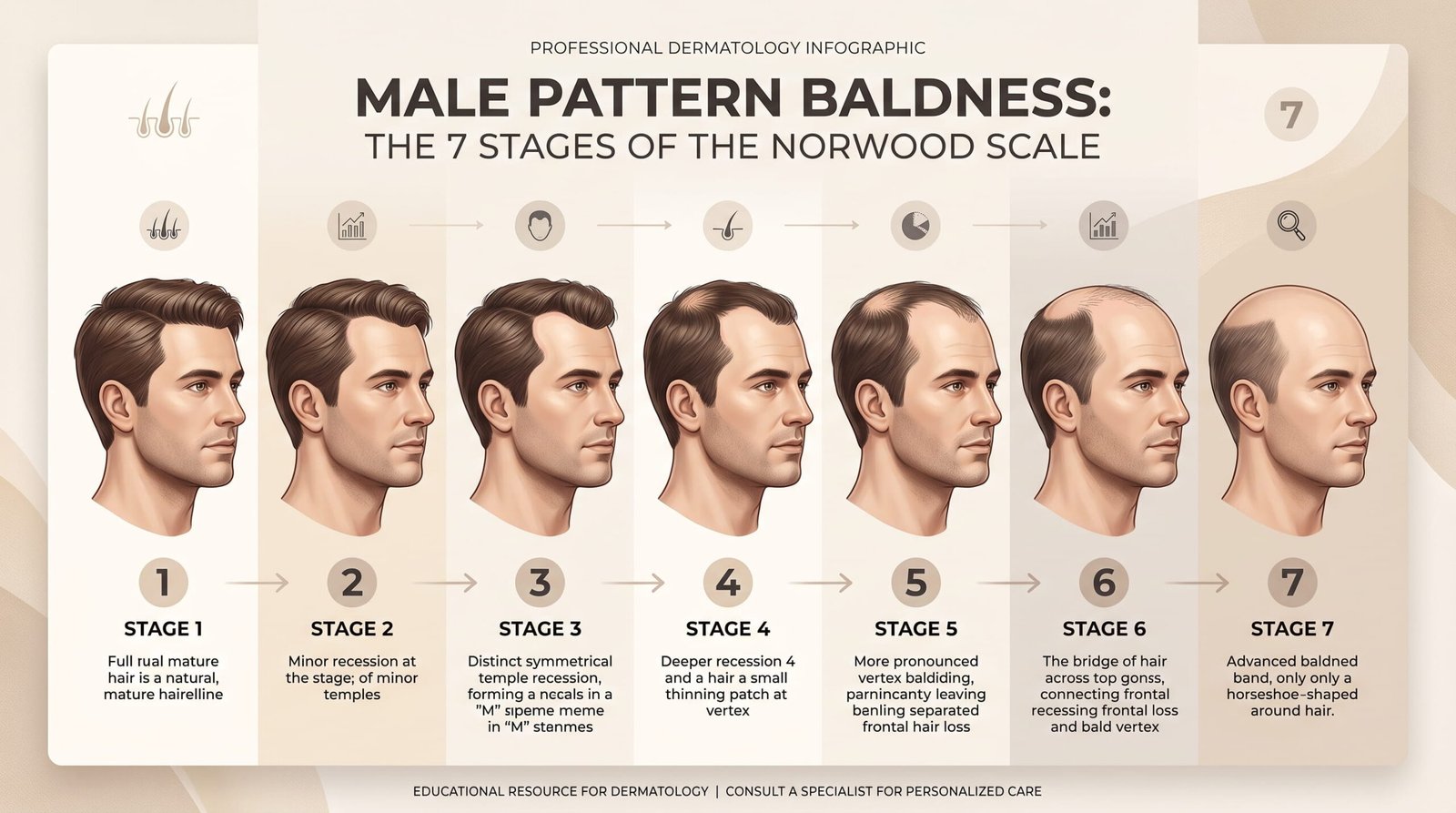
The Norwood Scale is also known as the Hamilton Norwood Scale. The Norwood Scale divides male pattern hair loss into seven stages. These range from no visible hair loss to extensive hair thinning across the top.
Medically, male pattern hair loss is known as alopecia. It is a condition that usually progresses over many years.
Understanding the Norwood Scale will help you identify the general stage of hair loss. You can also track the changes over time and have an informed conversation with your dermatologist or specialist in hair restoration. The scale is a guideline and does not identify all possible causes of hair loss.
What is the Norwood Scale of measurement?
The Norwood Scale was developed to classify male pattern baldness.
James Hamilton created a classification system in 1950, which O’Tar Norwood modified and expanded.
The traditional system consists of seven stages.
- Norwood stage 1: No noticeable hair loss
- Norwood stage 2: Mild recessive around the temples
- Norwood stage 3: More pronounced time recession
- Norwood stage 4: Frontal recessiveness and/or crown thinned.
- Norwood stage 5: Greater areas of crown and frontal hair loss
- Norwood stage 6: Frontal and crown area become connected
- Norwood stage 7: Loss of hair on the top of the head.
The Norwood scale: Understanding the stages of balding” (https://www.medicalnewstoday.com/articles/327001?utm_source=chatgpt.com) is not the only variation. Medical News Today
Norwood Scale Stages Explained
Norwood Stage 1,
Stage 1 is characterized by a minimal or non-existent hair loss.
There is a minimal amount of recession at the temples and the frontal hairline.
Most men will remain in this phase or a close variation of it throughout their life.
Hairlines are different from person to person. A naturally high-set hairline doesn’t mean someone is suffering from male pattern hairloss.
Norwood Stage 2.
In the second stage, a mild recession is visible around your temples.
When viewed above, the hairline can begin to take on a subtle ‘M-shaped’ appearance.
The second stage can be difficult for some to differentiate from the normal maturation of hairline. It is important to determine if the recession continues over time.
Photographs taken every few months in similar lighting will help you determine if the hairline has changed.
Norwood Stage 3.
The hairline is more prominent in the temples, with a M, U or V shape. There may be very little hair in the recessed areas.
Some men can remain in this stage for many, many years while others progress to more advanced stages.
Early evaluation is important because the treatment focuses on preserving hair follicles rather than attempting to recreate them after extensive hair loss.
Norwood Stage 3 Vertex
The crown or vertex is the area at the back of the head. This pattern can show crown thinning before frontal recession.
It is important to remember that male pattern baldness does not always take a predictable course.
Norwood Stage 4,
The hair loss is more severe at this stage.
The crown may show thinning hair or even balding. There can be a band of hair that separates the vertex and frontal areas.
It is often more obvious at this stage that the hairline has not yet matured and that it is a progressive androgenetic condition.
Men who are at this stage can consider medical treatment in order to maintain their remaining hair. Depending on the goals they have, they may also discuss hair restoration procedures.
Norwood Stage 5,
Stage 5 is characterized by an increase in the area of hair loss on both the crown and frontal areas.
The hair bridge between the two areas gets thinner and less dense. The top of the head is much balder than Stage 4.
Hair loss can be quite visible at this stage, even without close inspection.
Norwood Stage 6,
In Stage 6, the areas of baldness on the crown and front have merged together.
This is a severe case of male pattern hair thinning.
Norwood Stage 7,
The Norwood Scale’s Stage 7 is its most advanced level.
The top of the head is bald or has no hair, but a thin hairline may be visible on the sides and the back.
The best treatment depends more on the individual than just the Norwood number.
What causes male pattern hair loss?
The male pattern of hair loss is caused by a combination genetic susceptibility, and androgen related follicles.
Androgen signaling in hair follicles susceptible to it contributes towards a process known as follicular minimization. The terminal hairs become thinner and finer, and the hair density in affected areas decreases.
Dihydrotestosterone (DHT) is a key androgen in this process. DHT alone does not guarantee baldness. Genetics influences the response of each hair follicle.
A family history is therefore a valuable clue. Both sides of the families can contribute to male pattern hair loss.
How does the Norwood Scale measure hair density?
Not exactly.
The Norwood Scale is used to evaluate the pattern of visible hair loss and its extent, particularly around the frontal, temple, and crown hairline.
The Norwood stage can be the same for two men, but their hair density may differ. The hair density of two men can be different. One may still have many tiny, fine hairs while the other may have a relatively low level.
A dermatologist will also consider other factors, such as the hair shaft diameter, the miniaturization of the hair, the visibility of the scalp, the shedding and the condition overall of the scalp.
How is the Norwood stage determined?
Assessments may include:
- Frontal hairline examination
- Temple recession
- Crown density
- Hair shaft thickness
- Hairs that are smaller than normal hair
- Family History
- Hair loss can last for a long time
- The rate of progress
- Scalp examination
The most common way to diagnose pattern hair loss is through clinical presentation. However, unusual patterns can require further investigation.
It is not always androgenetic.
Can Norwood Stage 2 Become Stage 3?
Yes.
The progression of male pattern hair loss can be gradual, from a mild temple recession up to a more severe frontal recession. The rate of progression is highly personal.
Some men will remain in the early stages for a long time, while others will progress faster.
Early assessment is important for this reason. The American Academy of Dermatology states that men get better results when they start treatment soon after noticing their hair loss.
Usually, results require constant use over time.
Finasteride
Finasteride, an oral prescription medication, reduces testosterone conversion to DHT.
Some men can use it to slow down the progression of hair loss and maintain or improve their hair density. It is a prescription drug with possible adverse effects. You should discuss it with a qualified health professional.
The treatment decisions should not be solely based on the Norwood number.
Is Hair Transplantation an Option?
Men with male pattern baldness can consider hair transplantation.
The Norwood stage is a tool that helps surgeons plan and understand realistic expectations. Donor supply, hair characteristics and age are important factors.
Norwood advanced stages may require extra planning, as there may not be enough donor hair available to cover the entire area.
What is PRP for Norwood hair loss?
The PRP procedure involves drawing blood from a patient, concentrating platelets and injecting it into the scalp.
Some clinicians include PRP in their treatment plans for pattern hair loss. Results can vary and there is no guarantee that it will restore a hairline.
A qualified clinician can help anyone considering PRP to discuss realistic expectations, cost, schedule, and the evidence.
What Diet affects Norwood hair loss?
Some nutritional deficiencies may cause or worsen certain forms of hair loss. Inadequate nutrition or specific deficiencies can contribute to diffuse hair shedding.
It is not always beneficial to take large amounts of hair supplements if you haven’t confirmed a deficiency.
Can shampoo reverse Norwood hair loss?
Normal shampoos cannot usually reverse advanced androgenetic hair loss.
A good shampoo will help to maintain a healthy hair follicle and can remove excess oil.
Avoid products that claim to reverse severe baldness completely without any clinical evidence.
When should you see a dermatologist?
Professional evaluation can be particularly helpful when:
- Hair loss is advancing quickly
- You develop bald patches
- You may notice that your scalp is red, painful or scaly.
- Your hair suddenly starts to fall out
- Hair loss begins unexpectedly
- You don’t know the cause
- You wish to begin prescription treatment
- You’re considering a hair-transplant
Hair loss that is not a pattern usually occurs slowly and without scarring. Other types of hair loss can be different in appearance and require a different treatment.
Norwood Stage Tracking
Take standard photographs to track your hair loss rather than relying on your memory.
Take pictures from:
- Front
- Right temple
- Right temple
- Top
- Crown
Keep the lighting, distance from camera, hairstyle and head position constant.
Compare photos every three to six months to see the gradual changes.
Norwood Scale For Women
Norwood Scales are primarily used to diagnose male pattern hairloss.The distribution of pattern hair loss in women is usually different. Female pattern hair loss is often characterized by a diffuse thinning of the scalp in the middle, while the frontal hairline can remain relatively intact.
Conclusion
The Norwood Scale is a useful way to describe male pattern hair loss. It ranges from minimal thinning in Stage 1 up to a significant loss of hair on the top of the head in Stage 7.
The progression of male pattern hair loss may vary from one person to another, and there are other hair loss causes that can cause similar changes.
A dermatological evaluation is worthwhile if you notice crown thinning or progressive recession. Finasteride and minoxidil can help slow down the progression of hair loss and preserve existing hair.
Frequently Answered Questions (FAQs)
1. What does the Norwood Scale mean?
The Norwood Scale, a seven-stage system of classification is used to describe male pattern hair loss.
2. What does Norwood Stage 1 mean?
Stage 1 is characterized by a minimal or non-existent hair loss.
3. What does Norwood Stage 2 mean?
Stage two is characterized by a mild recessive area around the temples. It may also be a mature hairline.
4. Norwood Stage 3?
The third stage is characterized by a more obvious recess around the temples. It’s generally the first stage that can be recognized as male pattern baldness.
5. What is the Norwood 3 Vertex?
Norwood 3 Vertex is a pattern where noticeable hair loss can occur at the crown, while the frontal part of the hairline may still look like an earlier stage.
6. Is Norwood Stage 4 severe?
Stage four is characterized by a more advanced stage of hair loss with frontal recessiveness and/or crown thinning.
7. Can Norwood Stage 5 hair grow back?
Treatments can improve or preserve hair growth, but the rate of regrowth is variable. Your dermatologist will determine what options are best.
8. Can Norwood Stage 6 and 7 be treated with?
Hair restoration, medical treatment or cosmetic approaches can be considered based on donor hair, individual goals, and the type of hair transplantation.
9. Can diet stop male pattern baldness?
While a healthy diet can support normal hair growth, it cannot in general prevent genetically-determined male pattern baldness.
10. Should I consult a dermatologist about hair loss?
Consult a dermatologist for hair loss that is sudden, rapid or patchy. It may also be associated with scalp symptoms.