Nose Studs: Styles, Materials, Placement & Complete Guide
A nose stud can be a tiny accessory, but it can make a noticeable difference to your overall appearance. Whether you prefer a delicate gemstone, classic metal design, or a more eye-catching piece, nose studs offer an easy way to express personal style.
However, choosing nose jewelry is about more than appearance. The material, size, shape, fit, placement, and quality all matter, especially if the piercing is new or still healing.
With so many designs available, it can be difficult to know which nose stud is right for you. Understanding the different styles and materials can make shopping much easier while helping you choose jewelry that is comfortable and suitable for your piercing.
What Are Nose Studs?
A nose stud is a small piece of jewelry designed to be worn through a nose piercing, most commonly a nostril piercing. Unlike larger nose rings, studs usually have a small decorative end that sits close to the skin.
They are available in many designs, including:
- Plain metal studs
- Gemstone studs
- Diamond-style studs
- Flat-top studs
- Gold nose studs
- Silver-toned designs
- Colored gemstone styles
- Minimalist studs
- Decorative shapes
The design you choose can create anything from a barely noticeable accent to a bold statement.
Why Are Nose Studs So Popular?
Nose studs have remained popular because they can be both stylish and versatile. A tiny stud can complement everyday outfits without overpowering other accessories.
They can also be coordinated with earrings, necklaces, bracelets, or other facial jewelry. A simple metal stud can create a minimalist appearance, while a colorful gemstone can add personality.
Another advantage is the wide variety of available designs. You can choose jewelry according to your preferred aesthetic rather than being limited to one particular style.
Popular Nose Stud Styles
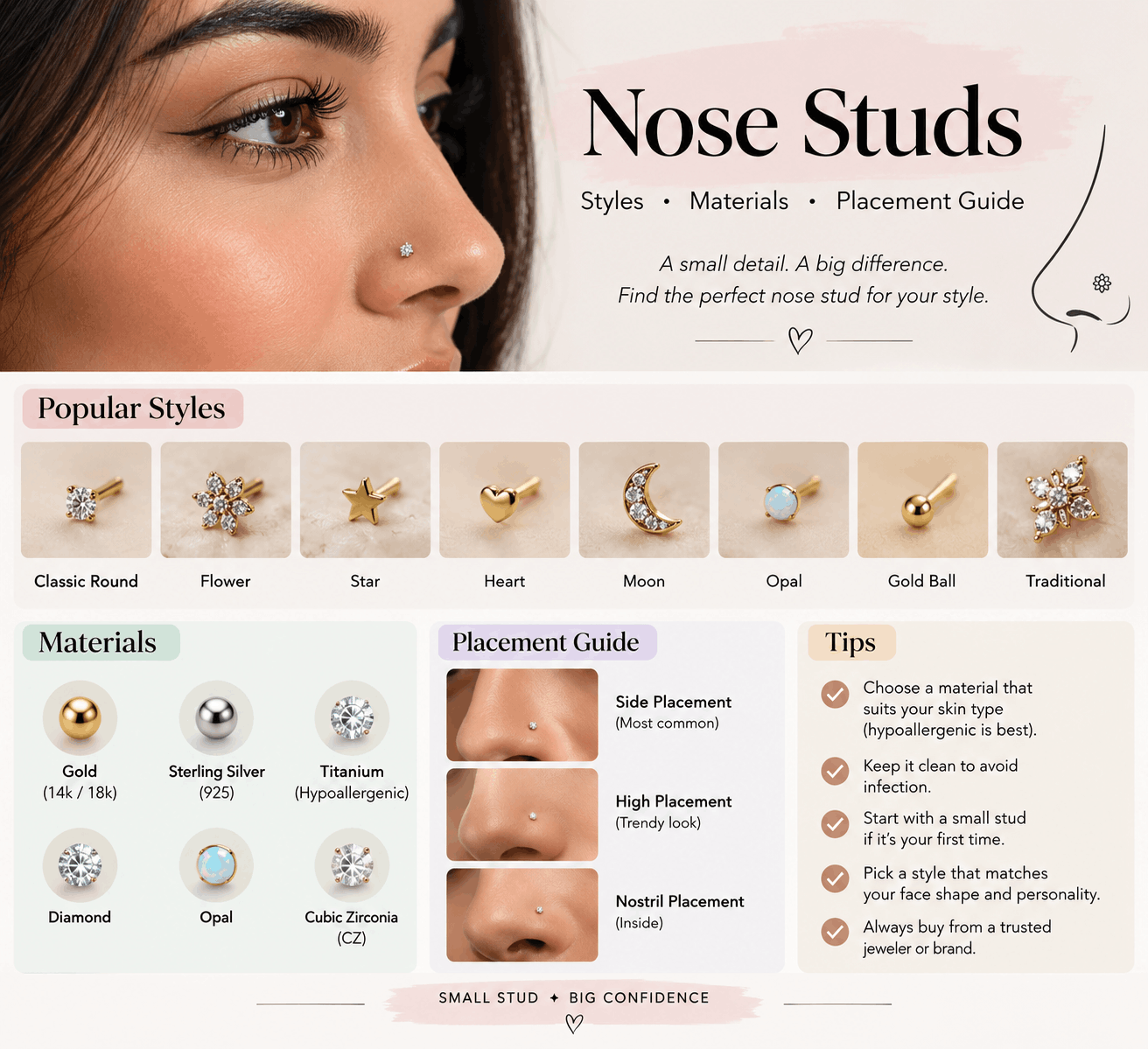
1. Classic Metal Nose Stud
A classic metal nose stud is one of the simplest choices. It may feature a tiny polished ball, disc, or other uncomplicated shape.
This style works particularly well for people who prefer subtle jewelry that can be worn with almost any outfit.
2. Gemstone Nose Stud
Gemstone studs add sparkle while keeping the overall design relatively small.
Clear stones are versatile, while colored gemstones can provide a more distinctive appearance. When choosing gemstone jewelry, make sure the setting is smooth and secure and that the piece is appropriate for your piercing.
3. Flat-Top Nose Stud
Flat-top studs have a low-profile decorative surface that sits relatively close to the skin.
They are a popular choice for minimalist looks because they can appear neat and understated.
4. Nostril Screw
A nostril screw has a curved section designed to help keep the jewelry positioned inside the nostril. Professional piercing guidance notes that the dimensions and shape should be fitted to the individual’s anatomy.
5. Nose Bone
A nose bone typically has a short straight post with a decorative end and a small ball-like backing.
According to the Association of Professional Piercers, nose bones are generally better reserved for healed piercings rather than fresh ones.
6. Labret-Style Nose Stud
A flat-back or labret-style piece uses a flat disc on the inside and a decorative end on the outside.
This construction can provide a clean appearance, but the correct length and fit are important.
Nose Stud Materials
Material is one of the most important considerations when choosing nose jewelry.
A beautiful design is not necessarily a good choice if its material is unsuitable for a body piercing. For a new piercing, the Association of Professional Piercers recommends appropriate body-jewelry materials such as implant-grade titanium, suitable gold, and niobium.
Implant-Grade Titanium
Titanium is a popular material for body jewelry because it is lightweight and can be a suitable option for people concerned about nickel sensitivity.
For initial piercings, look for appropriately certified implant-grade titanium rather than simply relying on the word “titanium” in a product description.
Gold
Gold can be an attractive choice for nose jewelry, but not every gold-colored piece is suitable for a fresh piercing.
Professional piercing guidance recommends solid gold of appropriate purity and composition for initial piercings, rather than gold-plated or gold-filled jewelry.
Niobium
Niobium is another material that has been used successfully in body jewelry. It can also be anodized to create different colors.
Stainless Steel
Some forms of implant-grade steel are used for body jewelry, but the quality and certification matter. Avoid assuming that every product simply labeled “stainless steel” is appropriate for a fresh piercing.
How to Choose the Right Nose Stud
The best nose stud depends on more than the design you like in a photograph.
Consider these factors before purchasing:
Consider Your Piercing Stage
A new piercing needs different consideration from a completely healed piercing.
Fresh piercings require jewelry that is appropriately sized and made from suitable materials. The Association of Professional Piercers emphasizes that jewelry for fresh piercings should be selected according to anatomy, size, style, and material.
Choose the Correct Size
A nose stud should not be excessively tight or unnecessarily loose.
Jewelry that is too tight may place pressure on the tissue, while jewelry that is too large may catch on clothing, towels, or other objects.
The correct size depends on the individual’s anatomy and piercing placement.
Check the Finish
Good body jewelry should have smooth surfaces without sharp edges, scratches, or rough areas.
The APP specifically recommends smooth jewelry surfaces and appropriate finishes for body jewelry.
Think About Your Lifestyle
If you are active, work around equipment, participate in sports, or frequently wear masks, a low-profile nose stud may be more practical than a large decorative design.
Nose Stud Placement
Placement can significantly affect how a nose stud looks.
Two people may wear identical jewelry but have completely different results because their nose shape and piercing placement are different.
A professional piercer should evaluate your anatomy before creating a new piercing. Placement should not simply be copied from a photograph of someone else.
Why Anatomy Matters
Everyone’s nose has a different shape, width, contour, and tissue structure.
A professional can assess the available tissue and help determine a placement that works with your anatomy and intended jewelry.
Professional guidance also emphasizes that body jewelry is not one-size-fits-all and should be appropriately fitted to the individual.
Nose Studs for Different Styles
Minimalist Nose Studs
If you prefer a subtle appearance, choose a tiny metal or clear gemstone stud.
Minimalist designs can complement everyday clothing and other jewelry without becoming the main focus.
Elegant Nose Studs
A small gemstone or polished gold design can create a refined appearance.
This type of jewelry can work particularly well when you want your piercing to look sophisticated rather than dramatic.
Bold Nose Studs
For a statement appearance, consider larger gemstones, unusual shapes, or distinctive colors.
The key is to keep the jewelry comfortable and appropriately fitted even when choosing a more noticeable design.
Traditional-Inspired Nose Jewelry
Decorative nose jewelry can also complement traditional and cultural fashion. Depending on the design, a small stud can be paired with other jewelry for weddings, celebrations, or formal occasions.
Gold vs. Silver Nose Studs
Both jewelry create very different visual effects.
Gold:
Warm, classic, and luxurious.
Silver-toned:
Cool, clean, and minimalist.
Rose gold:
Soft and feminine-looking.
Dark metal finishes:
More alternative and distinctive.
However, remember that the visible color does not necessarily tell you what the jewelry is actually made from. Always check the material specification.
How to Care for a New Nose Stud
Proper aftercare is especially important while a nose piercing is healing.
Follow the written instructions provided by your professional piercer and avoid unnecessary handling of the jewelry.
Try not to:
- Twist the jewelry repeatedly
- Pull or rotate the stud
- Touch the piercing with dirty hands
- Change jewelry prematurely
- Use harsh products around the piercing
- Catch the jewelry on clothing or towels
The goal is to minimize unnecessary irritation while the piercing heals.
When Can You Change a Nose Stud?
Changing jewelry too early can cause problems because a piercing may appear healed externally while the internal tissue is still healing.
For a new piercing, follow the advice of your professional piercer before changing the original jewelry.
If you are unsure whether the piercing is ready, having a professional inspect it is safer than experimenting with jewelry changes yourself.
For a healed piercing, the APP recommends ensuring that your hands, jewelry, piercing site, and work area are clean before changing jewelry. It also advises never forcing jewelry through a piercing.
Signs Your Nose Stud May Not Be Suitable
Pay attention to persistent discomfort around your jewelry.
Potential warning signs include:
- Ongoing irritation
- Increasing redness
- Swelling
- Itching
- Pain
- Jewelry pressing into the skin
- A loose stone or damaged setting
- Rough or sharp edges
If jewelry causes irritation, the APP recommends replacing it rather than continuing to wear a problematic piece simply because you like its appearance.
If you experience significant swelling, worsening pain, pus-like discharge, fever, or other concerning symptoms, seek medical advice.
Common Nose Stud Mistakes
Choosing Jewelry Only for Appearance
A beautiful nose stud is not automatically suitable for your piercing.
Always consider material, size, construction, and fit.
Buying Unknown Metals
Cheap jewelry with unclear material information may not be the best choice, particularly for a new piercing.
Choosing Jewelry That Is Too Tight
A stud should not constantly press into the surrounding tissue.
Changing Jewelry Too Soon
Patience is important during healing. Ask your piercer before switching jewelry.
Forcing Jewelry Into a Piercing
Never force a nose stud through a piercing if it does not insert easily. Forcing jewelry can damage tissue.
How to Style Nose Studs
A nose stud can be styled in many different ways.
For a minimalist look, pair a tiny silver-toned or titanium-colored stud with simple earrings.
For a warmer appearance, coordinate a gold nose stud with gold earrings or a delicate necklace.
If you prefer more personality, a colored gemstone can become a small accent that complements your outfit.
You can also choose jewelry according to the occasion. Minimal pieces work well for everyday wear, while decorative gemstones may be better suited to parties and special events.
How to Keep Your Nose Stud Looking Good
Cleanliness and gentle handling are important for both jewelry and piercing comfort.
Avoid constantly touching your nose stud. If it becomes dirty, follow appropriate cleaning instructions rather than aggressively rubbing the jewelry or surrounding skin.
Inspect the jewelry occasionally for damage, especially if it contains a gemstone.
If you notice a loose stone, rough surface, broken component, or other defect, replace the jewelry with a properly fitted piece.
Conclusion
The perfect nose stud combines style, comfort, appropriate material, and proper fit. From minimalist metal designs and tiny gemstones to decorative statement pieces, there are countless options for expressing your personality.
For a fresh piercing, safety should come before appearance. Implant-grade titanium, suitable gold, and other appropriate body-jewelry materials can be considered with guidance from a qualified piercer.
Placement and sizing are equally important because everyone’s anatomy is different. A professional piercer can help select jewelry that fits correctly and is suitable for the stage of healing.
Once your piercing is fully healed, experimenting with different colors, shapes, finishes, and gemstones can be a fun way to refresh your look. Whether your style is elegant, minimalist, traditional, or bold, the right nose stud can become a beautiful everyday accessory.
FAQs About Nose Studs
1. What is the best material for a nose stud?
Implant-grade titanium is a commonly recommended option, while suitable solid gold and niobium can also be appropriate. Material should be selected according to the piercing and individual needs.
2. What type of nose stud is best for a new piercing?
The appropriate style depends on your anatomy and piercing placement. A professional piercer should select the correct size, style, and material for a fresh piercing.
3. Are gold nose studs safe?
Suitable solid gold can be appropriate for body jewelry, but gold-plated, gold-filled, and similar products should not automatically be treated as equivalent.
4. Are nose studs better than nose rings?
Neither is universally better. Studs usually create a smaller, more subtle appearance, while rings offer a different aesthetic. The best option depends on personal preference, anatomy, and piercing stage.
5. How long should I wait before changing a nose stud?
Do not change new jewelry simply because the outside appears healed. Ask your professional piercer when your piercing is ready for a jewelry change.
6. Can I sleep with a nose stud?
A properly fitted stud can generally be worn continuously once the piercing is established, but comfort depends on the jewelry design. Avoid jewelry that catches on bedding or causes irritation.
7. What size nose stud should I choose?
There is no universal size. The appropriate length, gauge, and decorative size depend on your anatomy and piercing placement.
8. Can I wear a nose stud every day?
Yes. Many people wear nose studs as everyday jewelry. Choose a comfortable, properly fitted piece made from an appropriate material.
9. What should I do if my nose stud feels tight?
Do not ignore persistent pressure or attempt to forcefully adjust the jewelry. Contact a professional piercer so the fit can be assessed.
10. Can I change my nose stud myself?
For a fully healed piercing, changing jewelry at home may be possible if you can do so cleanly and without force. If the jewelry does not go in easily, stop and see a professional piercer rather than forcing it.