Quick Dry Nail Lacquers: Guide to Fast-Drying Nail Polish
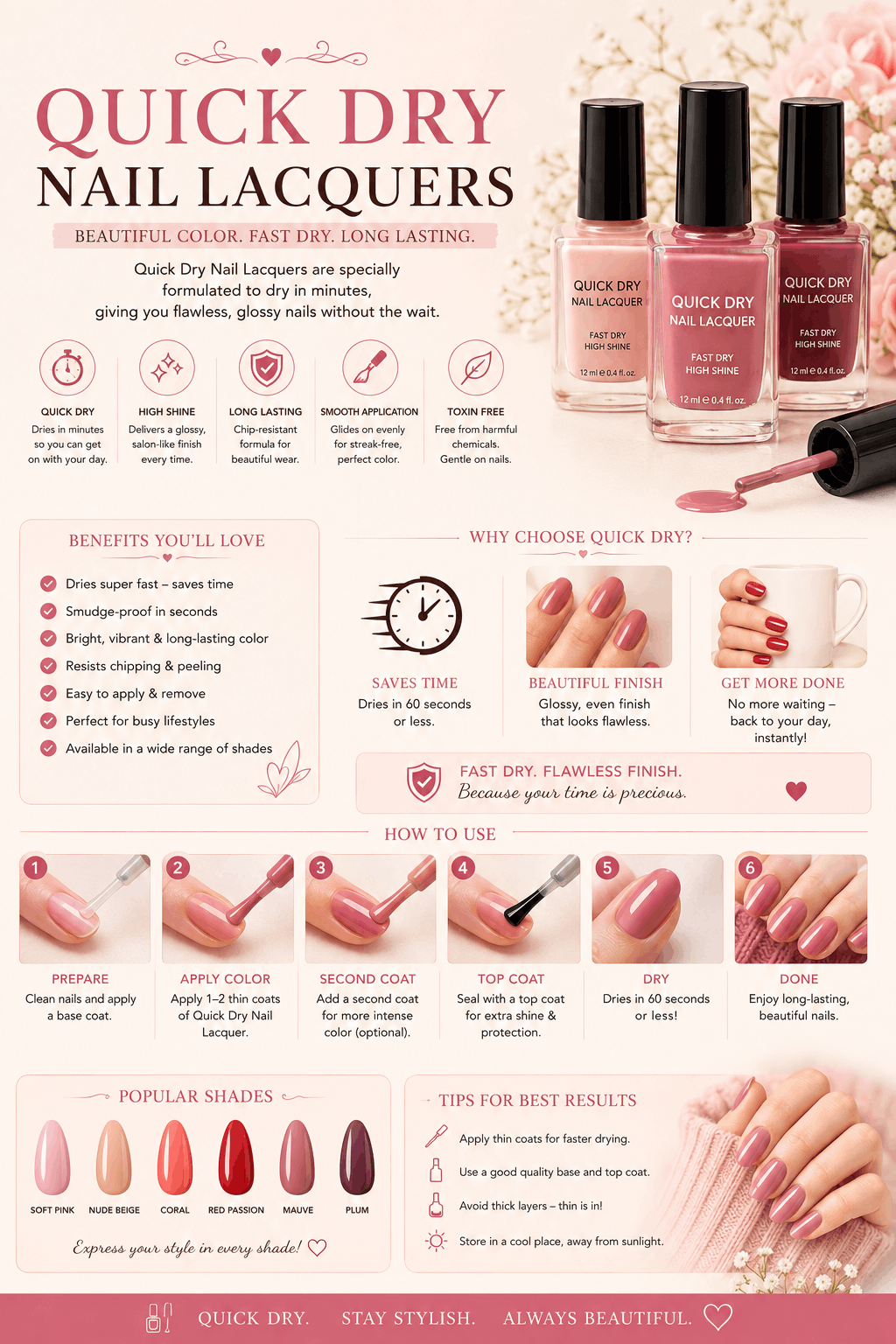
A fresh coat of nail polish can instantly make your hands look polished and put together, but waiting for wet lacquer to dry can be one of the most frustrating parts of doing a manicure. One accidental touch against clothing, a phone, or a countertop can leave a visible mark. This is where quick dry nail lacquers have become a practical beauty solution.
Quick-drying nail lacquers are designed to reduce the time needed for a manicure to become resistant to smudging. They are particularly useful for people who want attractive nails but do not have the time or patience to sit still for an extended drying period.
Unlike gel polish, quick-dry lacquer normally dries without a UV or LED curing lamp. Its performance comes from the formulation itself, including solvents and film-forming ingredients that help the coating set more rapidly. Some commercial quick-dry products currently claim to become smudge-resistant in approximately one minute, although real-world drying time can vary.
What Are Quick Dry Nail Lacquers?
Quick dry nail lacquers are nail-polish formulas developed to shorten the drying period compared with conventional nail polish.
They are still traditional nail lacquers rather than gel systems. Once brushed onto the nail, volatile ingredients evaporate and the remaining components form a solid film.
The main attraction is convenience. Instead of planning your manicure around a long drying period, you can generally get back to normal activities sooner.
However, “quick dry” does not mean “instantly hardened.” A polish can feel dry on the surface while the layers underneath are still susceptible to pressure or dents.
Why Does Quick Dry Nail Polish Dry Faster?
The drying behavior of nail lacquer is strongly influenced by its ingredients.
Typical formulas contain solvents that evaporate after application. Quick-dry products are formulated to encourage this process, helping the coating reach a usable state more rapidly.
For example, current quick-dry lacquer formulas can include ingredients such as ethyl acetate, butyl acetate, nitrocellulose, alcohols, and plasticizing or film-forming components.
The exact formula differs between manufacturers, so one quick-dry polish may behave differently from another.
Quick Dry Lacquer vs. Ordinary Nail Polish
Both products provide color and a decorative finish, but their formulations can be optimized for different experiences.
Regular nail polish may require more time before it becomes resistant to accidental contact. Quick-dry lacquer is intended to shorten that waiting period.
The trade-off is not necessarily about quality. Instead, the major difference is how quickly the product reaches a usable state.
If your priority is convenience, a fast-setting formula can be appealing. If you enjoy experimenting with different polish types, traditional formulas may still have a place in your collection.
Quick Dry Lacquer vs. Gel Polish
Both are two different categories.
Quick Dry Nail Lacquer
- Dries through evaporation
- Usually does not require a curing lamp
- Can generally be removed with conventional nail-polish remover
- Works directly on natural nails
- Suitable for quick color changes
Gel Polish
- Requires curing under a suitable lamp
- Uses a gel-based formulation
- Usually requires a more involved removal process
- Is designed for longer-lasting wear
This distinction is important because a quick-drying lacquer should not automatically be treated as a substitute for a gel system.
Main Advantages of Quick Dry Nail Lacquers
1. Less Waiting
The biggest advantage is obvious: you spend less time worrying about whether your freshly painted nails are still wet.
2. Convenient for Busy Days
A fast manicure can be useful before work, a meeting, dinner, travel, or a social event.
3. No Curing Equipment
You can apply regular quick-dry lacquer without purchasing or using a UV or LED nail lamp.
4. Easy Color Changes
If you like changing nail colors frequently, conventional lacquer is generally more convenient than a gel system.
5. Variety of Finishes
Quick-dry formulas can be found in numerous shades and finishes, including creams, shimmers, metallics, glitter, and sheer colors.
6. Useful for Last-Minute Manicures
When you suddenly decide that your nails need a fresh look, a fast-setting polish can save valuable time.
How to Apply Quick Dry Nail Lacquer Correctly
The application technique can make a surprisingly large difference in the final result.
Start With Clean Nails
Remove old polish and clean the nail surface. Oils, creams, and residue can interfere with smooth application.
Shape the Nails
File the edges into your preferred shape. Avoid excessive filing because unnecessary thinning can make natural nails more fragile.
Apply a Base Coat
A base coat can provide a smoother surface and may help prevent staining from highly pigmented shades. Dermatology guidance also recommends base coats as part of sensible manicure care.
Paint a Thin Layer
Use a moderate amount of polish rather than flooding the nail with product.
Thin layers generally set more efficiently than heavy coats.
Add a Second Coat if Necessary
If the first layer does not provide enough color, wait briefly and apply another light coat.
Seal the Tip
Brushing a small amount across the free edge of the nail can help create a more complete finish.
Finish With a Top Coat
A compatible top coat can add gloss and provide another layer of protection. Some quick-dry systems are specifically designed to work with their own finishing products.
How Long Do Quick Dry Nail Lacquers Take to Dry?
There is no universal drying time.
A product’s performance can depend on:
- Formula
- Number of coats
- Thickness of each coat
- Room temperature
- Humidity
- Nail preparation
- Top coat
- Age and condition of the polish
Some specialized products advertise extremely fast results. For instance, OPI’s current RapiDry range states that its lacquer can become smudge-proof in about 60 seconds under its recommended use.
That should not be interpreted as a universal drying time for every quick-dry nail lacquer.
Why Is My Quick Dry Polish Still Smudging?
A quick-dry formula can still smudge when the application is too thick.
One heavy coat may take considerably longer to set than several carefully applied thin layers.
Other common reasons include:
- Applying coats too close together
- Using too much polish
- Touching the nails too soon
- Applying polish over oily nails
- Using an incompatible top coat
- Working in a humid environment
If the surface feels dry but the polish dents easily, give it additional time before performing activities that put pressure on the nails.
How to Make a Manicure Dry Even Faster
Choosing a quick-dry lacquer is only part of the solution.
Keep Coats Thin
This is one of the simplest ways to improve drying performance.
Prepare the Nail Surface
A clean nail allows the polish to spread more evenly.
Avoid Repeated Brushing
Going over the same wet area again and again can disturb the coating.
Use a Fast-Drying Top Coat
A suitable quick-dry top coat can help reduce finishing time.
Close the Bottle Between Coats
Keeping the bottle open unnecessarily allows volatile components to escape.
Give the Manicure a Little Extra Time
Even if the polish feels dry quickly, avoid immediately putting your hands through activities that can dent the surface.
Why Does Quick Dry Polish Become Thick?
There is a simple reason many fast-drying polishes eventually become difficult to apply: exposure to air.
The volatile components that help lacquer spread and dry can gradually evaporate every time the bottle is opened. As that happens, the remaining product can become thicker.
Quick-dry formulas may be especially noticeable in this regard because fast evaporation is part of their intended behavior.
To keep the product usable:
- Close the cap immediately after application.
- Keep the bottle upright.
- Avoid leaving it open while deciding what to do next.
- Follow the manufacturer’s storage instructions.
- Use an appropriate nail-polish thinner if the manufacturer recommends one.
Do not randomly add household liquids to nail polish because doing so can alter the formulation.
How to Choose a Quick Dry Nail Lacquer
Not every fast-drying polish will give the same experience.
Look at the Brush
A brush that distributes polish evenly can make application much easier.
Some modern products use wider brushes designed to spread the lacquer efficiently across the nail.
Consider the Finish
Think about the appearance you want:
- Glossy
- Natural
- Matte
- Shimmering
- Metallic
- Glitter
- Sheer
Check the Application Instructions
Manufacturers may recommend a specific number of coats or a particular top coat.
Review Ingredients if You Have Sensitive Skin
If nail products have caused irritation in the past, check the ingredient list carefully and discuss recurring reactions with a qualified healthcare professional.
Best Quick Dry Nail Lacquer Colors for Different Looks
The beauty of nail lacquer is that color can completely change the mood of a manicure.
Soft Nude
Ideal for an understated everyday appearance.
Classic Red
A timeless choice that works well for both casual and formal occasions.
Pink
Light pink can create a clean, delicate appearance, while deeper pinks offer a more noticeable finish.
Burgundy
A rich burgundy shade can give nails a sophisticated autumn or evening look.
Black
Black lacquer creates a bold, modern manicure.
White
White nails can look fresh and striking when applied evenly.
Pastel Shades
Lavender, mint, peach, and pale blue are popular choices for softer seasonal styles.
Quick Dry Nail Lacquer for Short Nails
Short nails can look especially polished with fast-drying lacquer because there is less surface area to cover.
Simple colors often work beautifully on shorter nails.
Try:
- Nude
- Soft pink
- Deep red
- Chocolate brown
- Navy
- Burgundy
- Milky white
Minimal nail art can also complement short nails without making them appear crowded.
Quick Dry Nail Lacquer for Long Nails
Longer nails provide more room for creativity.
You can experiment with:
- French tips
- Color blocking
- Metallic accents
- Ombre-inspired designs
- Glitter details
- Negative-space patterns
Because long nails can be more prone to accidental contact with objects, a fast-setting formula may be especially convenient during application.
Is Quick Dry Nail Lacquer Safe for Natural Nails?
Conventional nail lacquer can be used as part of a normal cosmetic routine, but nail health still deserves attention.
Problems may arise from factors such as excessive filing, harsh removal, frequent exposure to drying products, or picking at damaged polish.
If your nails become repeatedly brittle, split, peel, discolor, or develop another persistent change, it is better to stop covering the problem and determine the cause.
Moisturizing the nails and surrounding skin after removing polish is also a useful part of basic nail care.
How to Remove Quick Dry Nail Lacquer
One advantage of traditional lacquer is that removal is generally straightforward.
Apply an appropriate nail-polish remover to a cotton pad and gently wipe away the polish.
Avoid aggressively scraping the nail surface.
After removal:
- Wash your hands.
- Dry them gently.
- Apply moisturizer.
- Pay attention to the cuticles and surrounding skin.
- Allow the nails a break if they feel dry or fragile.
Common Mistakes People Make
Applying a Very Thick Coat
This can create a surface that feels dry while the lower layers remain soft.
Touching the Nails Too Soon
Even fast-drying lacquer needs time to become sufficiently resistant to pressure.
Picking at Chipped Polish
Picking can disturb the natural nail underneath.
Filing Too Aggressively
Excessive buffing or filing can make natural nails thinner.
Leaving the Bottle Open
This can accelerate solvent evaporation and cause the lacquer to thicken.
Ignoring Nail Changes
Persistent discoloration, pain, swelling, lifting, or other unusual changes should not simply be hidden beneath another layer of polish.
How to Make Quick Dry Nail Lacquer Last Longer
Fast drying and long wear are not exactly the same thing.
To improve the life of your manicure:
- Begin with clean nails.
- Use thin coats.
- Seal the free edge.
- Use a suitable top coat.
- Avoid using your nails as tools.
- Wear gloves during chores involving prolonged water or cleaning products.
- Moisturize your hands and nails regularly.
- Repair chips rather than picking at them.
The actual wear period varies from one product to another. Some manufacturers report several days of wear for their quick-dry formulas when used according to their recommended system.
Who Should Consider Quick Dry Nail Lacquer?
This type of polish can be particularly useful for people who:
- Have busy schedules
- Prefer traditional nail polish
- Change colors frequently
- Do not want to use a curing lamp
- Need a manicure before an event
- Prefer simple at-home nail care
- Dislike waiting for ordinary polish to dry
It can be a convenient middle ground between traditional slow-drying polish and more involved gel manicures.
Final Thoughts
Quick dry nail lacquers are designed around one simple beauty problem: nobody wants to spend ages protecting freshly painted nails from accidental smudges.
Their fast-setting nature makes them useful for everyday manicures, quick touch-ups, travel, and last-minute beauty routines. Modern formulas can combine rapidly evaporating solvents with film-forming ingredients to help the polish become usable sooner.
Still, technique matters. Thin coats, clean nails, appropriate drying time, careful removal, and proper bottle storage can make the entire experience better.
Most importantly, do not confuse a quick-dry surface with completely hardened polish. Give your manicure enough time to settle before putting your hands through demanding activities.
When used thoughtfully, quick dry nail lacquers offer a simple way to enjoy colorful, polished nails without the long waiting period associated with many conventional formulas.
Frequently Asked Questions
1. What are quick dry nail lacquers?
Quick dry nail lacquers are conventional nail-polish formulas designed to become dry or smudge-resistant faster than many standard nail polishes.
2. Do quick dry nail lacquers need a UV lamp?
No. Traditional quick-dry lacquer normally dries through evaporation and does not require UV or LED curing.
3. How fast can quick dry nail polish dry?
Drying time depends on the formula and application. Certain commercial products advertise smudge resistance in approximately 60 seconds, but this should not be assumed for every brand.
4. Can I apply two coats of quick dry polish?
Yes. Thin coats are generally preferable to one very thick coat because they can set more efficiently.
5. Why does my quick dry polish still smudge?
Possible causes include thick application, insufficient time between coats, excessive product, humidity, or touching the nails before the underlying layers have hardened.
6. Can quick dry nail lacquer damage natural nails?
The polish itself is not necessarily the sole cause of nail problems. Frequent removal, aggressive filing, picking, or poor nail-care habits can contribute to dryness and weakness.
7. How do I stop quick dry polish from becoming thick?
Keep the bottle tightly closed whenever you are not actively using it. Air exposure can allow volatile ingredients to evaporate and change the consistency.
8. Is quick dry lacquer the same as gel polish?
No. Quick-dry lacquer is a conventional polish that dries through evaporation, whereas gel polish uses a curing process and different product chemistry.
9. Can I use a top coat with quick dry nail lacquer?
Yes. A compatible top coat can add shine and help protect the finished manicure. Some quick-dry systems are specifically designed to be paired with a particular top coat.
10. How can I keep my quick-dry manicure looking fresh?
Apply thin coats, use an appropriate top coat, protect your hands during household chores, avoid using nails as tools, and moisturize the surrounding skin regularly.