Korean Makeup: Glass Skin, Eye Makeup, Lip Trends and Tips
Introduction
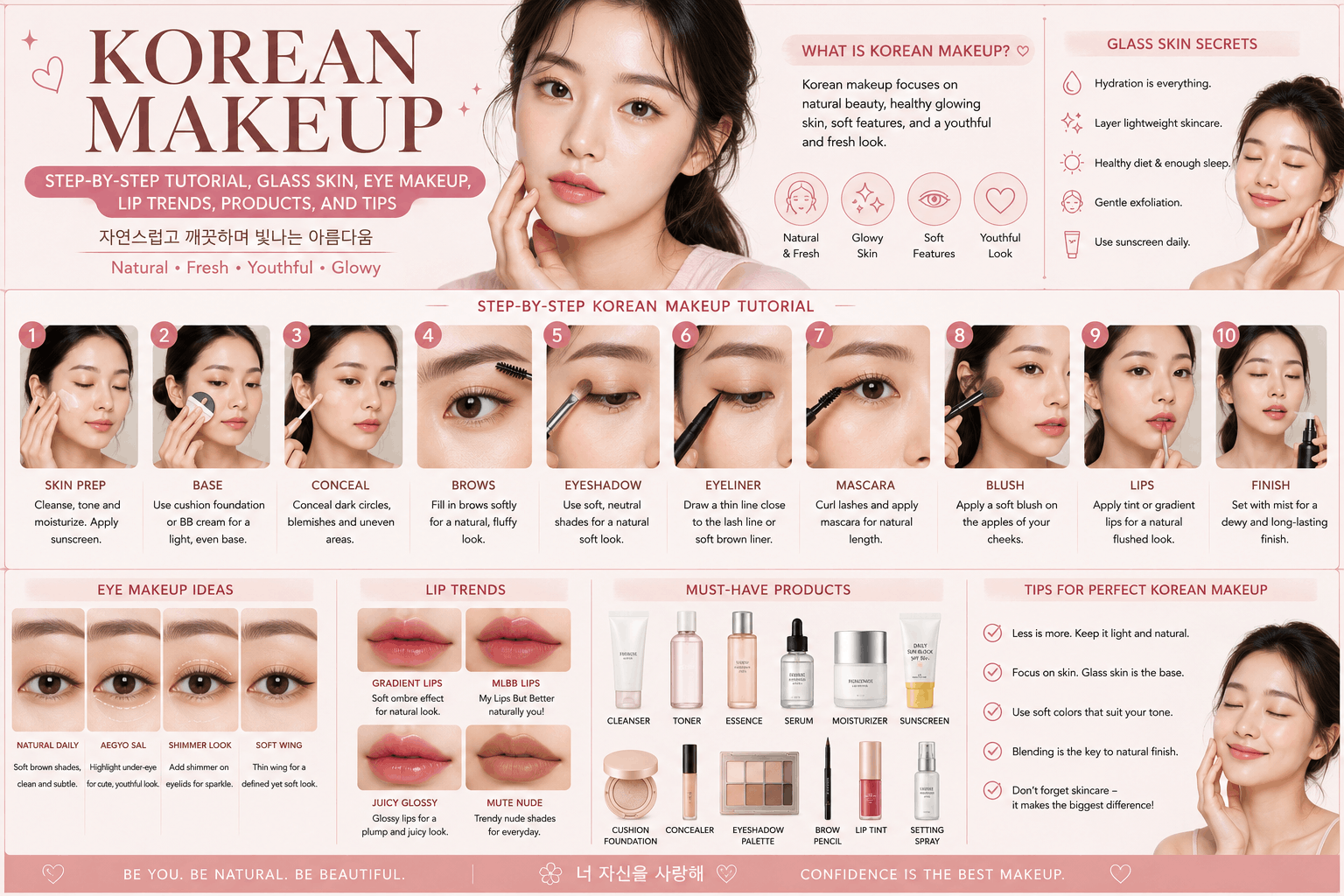
Korean makeup has become one of the most recognizable beauty styles around the world. Instead of relying on heavy coverage and dramatic contouring, the look often focuses on fresh-looking skin, soft colors, naturally defined eyes, subtle blush, and youthful-looking lips. Its popularity has also been strongly influenced by K-pop, Korean dramas, and the wider K-beauty movement.
One of the most recognizable features is the emphasis on skin. Rather than completely covering natural texture, Korean-inspired makeup often uses lightweight base products to create a fresh, luminous appearance. Glass-skin makeup, soft blush, aegyo-sal, puppy-style eyeliner, and gradient lips remain popular techniques, although the exact trends continue to evolve.
The good news is that you do not need to be a professional makeup artist to recreate this style. With the right preparation and a few simple techniques, you can create a soft Korean-inspired look for everyday wear, dates, photos, college, work, or special occasions.
What Is Korean Makeup?
Korean makeup is a beauty style that generally emphasizes a fresh, youthful, soft, and polished appearance. The focus is often on enhancing natural features rather than creating extremely sharp facial definition.
Typical characteristics include:
- Lightweight, luminous-looking skin
- Soft and natural brows
- Peach, pink, or coral blush
- Gentle eye makeup
- Thin eyeliner
- Defined lashes
- Aegyo-sal highlighting
- Soft contouring
- Gradient or blurred lips
- Glossy or hydrated-looking finishes
The style can range from almost makeup-free and natural to glamorous K-pop-inspired makeup. Modern Korean makeup is not limited to one exact formula; different looks adapt according to fashion, season, age, and personal preference.
Why Is Korean Makeup So Popular?
One reason for its popularity is its wearable appearance. A soft Korean-inspired look can be adapted for everyday life without requiring extremely heavy makeup.
Korean beauty has also been heavily influenced by entertainment and social media. K-pop performers and Korean actors have helped popularize bright eyes, luminous complexions, soft blush, and gradient lips internationally. K-pop-inspired tutorials continue to highlight techniques such as puppy eyes, aegyo-sal, and gradient lips.
Another attraction is that the style can work with many different levels of makeup. You can create a five-minute version or spend more time building a detailed idol-inspired look.
Korean Makeup vs Western Makeup
There is no single definition of either Korean or Western makeup because both styles include countless variations. However, there are some general differences often seen in tutorials.
| Korean-Inspired Makeup | Traditional Full-Glam Approach |
| Lightweight base | Fuller coverage |
| Luminous or satin skin | Matte or highly sculpted skin |
| Soft blush | Stronger contour and bronzer |
| Straight or softly shaped brows | More defined arch |
| Thin eyeliner | Dramatic liner |
| Soft eye colors | Strong smoky eyes |
| Gradient lips | Defined lip edges |
| Subtle contour | More noticeable contour |
| Fresh appearance | More dramatic finish |
Modern beauty is increasingly mixing these techniques, so you do not have to follow one style exclusively.
What You Need for Korean Makeup
You can create a Korean-inspired look with a relatively small collection.
Basic Products
- Moisturizer
- Sunscreen for daytime
- Lightweight primer
- Cushion foundation, BB cream, skin tint, or light foundation
- Concealer
- Setting powder
- Brow pencil or brow powder
- Brow gel
- Neutral eyeshadow
- Soft eyeliner
- Mascara
- Cream or powder blush
- Soft contour
- Highlighter
- Lip tint or lipstick
- Lip gloss
A cushion foundation can be particularly convenient because it makes it easy to apply thin layers of complexion product.
Step 1: Prepare the Skin
The Korean makeup look begins with skin preparation.
Clean your face and apply a moisturizer suitable for your skin type. For daytime makeup, apply sunscreen as part of your regular skincare routine.
Allow skincare to settle before applying makeup. The purpose is to create comfortable, hydrated-looking skin rather than applying numerous products simply because they are associated with Korean beauty.
The famous “glass skin” appearance is primarily a skin-finish concept rather than something produced by one magical makeup product. Current glass-skin guides emphasize hydration, smoothness, and maintaining the skin barrier.
Don’t Overdo Skincare Before Makeup
Too many layers can cause makeup to pill or slide.
Use products your skin already tolerates well, particularly before an important event.
Step 2: Create a Lightweight Base
Korean-inspired makeup generally works best when the complexion still looks like skin.
Apply a small amount of cushion foundation, BB cream, skin tint, or lightweight foundation.
Instead of covering the entire face with a thick layer, concentrate coverage where it is needed.
You can use a makeup sponge or cushion puff to gently press the product into the skin.
How to Get a Glass-Skin Finish
The goal is a complexion that looks:
- Hydrated
- Fresh
- Smooth
- Even
- Naturally luminous
Do not automatically cover every tiny pore or natural mark. Excessive foundation can actually make the face look less fresh.
A 2026 Korean beauty trend report continues to describe glass skin as a luminous, translucent-looking finish created through hydration and strategic highlighting rather than simply heavy foundation. (cyl.co.kr)
Step 3: Use Concealer Strategically
Apply concealer only where additional coverage is necessary.
You might use it under the eyes, around the nose, or over individual blemishes.
For a Korean-inspired finish, avoid creating an extremely thick, bright triangle under the eyes. A small amount can brighten the area while preserving a natural appearance.
Step 4: Set Only Where Necessary
If you want a dewy finish, do not cover your entire face with a thick layer of powder.
Instead, apply powder mainly to areas that become oily or where makeup tends to crease.
The cheeks and high points of the face can remain more luminous.
This balance helps prevent the complexion from becoming completely flat.
Step 5: Create Soft Korean Brows
Brows play an important role in the overall Korean makeup aesthetic.
Rather than creating an extremely sharp, high arch, many Korean-inspired looks use straighter or softly curved brows.
Fill sparse areas using light strokes and keep the front of the brow relatively soft.
Choose a brow shade that blends naturally with your hair and overall coloring.
A current K-pop-inspired approach emphasizes softly shaped brows and lighter, hair-like definition rather than a strongly outlined Instagram-style brow.
Step 6: Apply Soft Eyeshadow
Korean eye makeup usually emphasizes subtle dimension.
Try a small palette containing:
- Beige
- Taupe
- Soft brown
- Peach
- Pink
- Champagne
- Light coral
Start with a neutral shade across the lid.
Then apply a slightly deeper shade toward the outer portion of the eye and crease.
Blend everything carefully so there are no harsh edges.
Add a Little Shimmer
A small amount of champagne, pearl, or soft pink shimmer can brighten the eyelid.
Avoid covering the entire eye with intense glitter if you are aiming for an everyday Korean-inspired look.
Step 7: Try Puppy Eyeliner
Puppy eyeliner is one of the techniques associated with Korean and K-pop-inspired eye makeup.
Instead of creating a dramatic upward wing, the liner generally follows the lash line and extends outward in a softer or straighter direction.
This can give the eyes a more open and gentle appearance.
Use a thin eyeliner pen and begin with a very small line. You can always make it thicker.
Current K-pop-inspired tutorials frequently contrast the softer puppy-eye direction with the sharper upward cat-eye wing.
Step 8: Add Aegyo-Sal
Aegyo-sal refers to the small area of natural fullness beneath the lower lash line that becomes more noticeable when you smile. In Korean makeup, it is often emphasized with subtle shading and highlighting to make the eyes appear brighter and more youthful. (IVisitKorea)
How to Create Aegyo-Sal With Makeup
- Smile gently to identify the natural under-eye fullness.
- Use a small amount of taupe or soft brown shadow beneath the fuller area.
- Blend the line so it looks like a natural shadow.
- Add a small amount of light shimmer or brightening shade to the raised area.
- Blend carefully.
The result should be subtle.
The goal is to emphasize natural structure, not draw a strong dark line beneath the eyes.
Step 9: Apply Mascara
Korean-inspired lashes usually look separated and defined rather than extremely thick.
Curl your lashes if desired and apply mascara from the roots toward the tips.
Focus on:
- Length
- Separation
- Definition
If you use false lashes, choose a lightweight style that does not completely cover the soft eye makeup.
Step 10: Apply Korean-Style Blush
Blush is one of the easiest ways to create the youthful Korean makeup effect.
Popular colors include:
- Soft pink
- Peach
- Coral
- Rose
- Berry
- Muted apricot
Instead of heavily sculpting the cheekbones, apply blush high on the cheeks and blend softly.
Some current K-pop-inspired looks place blush relatively high and closer to the center of the face, sometimes extending a light wash toward the nose.
Cream vs Powder Blush
Cream blush can give a fresh, skin-like appearance.
Powder blush can provide longer-lasting color and is easy to build gradually.
Either can work.
Step 11: Use Soft Contour
Korean makeup generally does not require dramatic contour.
Use a subtle contour shade to add gentle structure around areas such as:
- Nose
- Jawline
- Hairline
- Cheek area
Blend thoroughly.
The objective is to create subtle definition that remains believable rather than visibly sculpted.
Step 12: Add a Touch of Highlighter
Use highlighter sparingly.
Apply a small amount to the high points of your cheeks, inner corners of the eyes, or other areas where you want light to catch.
For a glass-skin effect, cream or liquid highlighter can blend beautifully into the complexion.
Avoid applying too much product directly over textured areas.
Step 13: Create the Korean Gradient Lip
The gradient lip is one of the most recognizable Korean-inspired makeup techniques.
Instead of creating a strong outline around the entire mouth, the color is concentrated toward the center and softly fades toward the edges.
How to Create a Gradient Lip
- Apply a little lip balm if your lips are dry.
- Place lip tint or lipstick mainly in the center.
- Press your lips together gently.
- Use your fingertip or a small brush to blur the color outward.
- Leave the outer edge softer and lighter.
- Add a small amount of gloss to the center if desired.
The result should be darker in the center and progressively softer toward the edges. This technique remains a key part of Korean and K-pop-inspired makeup.
Korean Makeup for Different Skin Types
Oily Skin
You can still create luminous Korean makeup without making the entire face excessively shiny.
Use lightweight hydration and apply powder selectively to the T-zone.
A setting spray can also help depending on the products you use.
Dry Skin
Focus on comfortable hydration and avoid excessive powder.
Cream blush and lightweight luminous base products can help maintain a fresh finish.
Combination Skin
Use different techniques in different areas.
For example, you might keep the cheeks luminous while setting the forehead and nose more thoroughly.
Sensitive Skin
Keep your routine simple and avoid introducing several new products simultaneously.
Always follow product instructions and discontinue anything that causes irritation.
Korean Makeup for Beginners
If you are completely new to makeup, you do not need to attempt every technique immediately.
Start with:
- Moisturizer and sunscreen
- Skin tint or cushion
- Concealer
- Soft brows
- Peach or pink blush
- Neutral eyeshadow
- Mascara
- Lip tint
Once you are comfortable, add puppy eyeliner, aegyo-sal, contour, and gradient lips.
This approach makes learning much less overwhelming.
Korean Makeup for Different Occasions
Everyday Korean Makeup
Keep everything light:
- Sheer base
- Soft brows
- Peach blush
- Mascara
- Glossy or tinted lips
Korean Date-Night Makeup
Add:
- More eye definition
- Soft shimmer
- Slightly stronger blush
- Defined gradient lips
- Subtle contour
K-Pop Inspired Makeup
You can make the look more dramatic with:
- Sparkly eyeshadow
- Individual lashes
- Stronger blush
- Glossy lips
- More noticeable aegyo-sal
Korean Bridal-Inspired Makeup
For an event, use a longer-lasting base while maintaining the characteristic soft glow.
Add more definition to the eyes and lips while keeping the complexion fresh.
Common Korean Makeup Mistakes
Making the Base Too Heavy
Heavy foundation can hide the fresh skin effect.
Using Too Much Highlighter
The glass-skin effect is not simply about covering the face in highlighter.
Drawing Thick Eyeliner
A thick black wing can overpower the soft eye aesthetic.
Overdrawing the Aegyo-Sal
The shading should look subtle and follow your natural facial structure.
Making the Brows Too Dark
Very dark, sharply outlined brows can make the look appear harsher.
Applying Too Much Blush
Build color slowly.
Making the Gradient Lip Too Wide
The strongest color should remain near the center rather than reaching the outer edges immediately.
How to Make Korean Makeup Last Longer
A fresh, dewy look can sometimes be challenging to maintain throughout the day.
Try these techniques:
- Prepare your skin properly.
- Use lightweight layers.
- Allow skincare to settle before makeup.
- Powder only oily areas.
- Use long-wearing lip tint.
- Carry blotting paper.
- Touch up blush when necessary.
- Use setting spray appropriate for your skin and makeup.
Do not repeatedly add powder over oily skin without first removing excess oil. Blotting can help prevent a thick buildup.
Korean Makeup Trends in 2026
Korean makeup continues to evolve rather than remaining locked into one traditional look.
Current beauty coverage points toward several directions, including soft luminous skin, blurred or bitten lips, relaxed brows, watercolor-like blush, and more subtle eye definition.
At the same time, glass skin, gradient lips, and K-pop-inspired eye techniques remain highly recognizable parts of Korean beauty. (cyl.co.kr)
This means you can combine classic techniques with newer trends instead of following one rigid formula.
Korean Makeup Products: What to Look For
You do not have to buy a complete Korean makeup collection to achieve the look.
Instead, focus on product characteristics.
For Base
Look for:
- Lightweight texture
- Buildable coverage
- Natural or luminous finish
- Comfortable wear
For Eyes
Look for:
- Soft neutral shades
- Fine-tip eyeliner
- Separated mascara
- Subtle shimmer
For Cheeks
Look for:
- Sheer blush
- Buildable pigment
- Peach, pink, coral, or rose shades
For Lips
Look for:
- Lip tint
- Sheer lipstick
- Gloss
- Blurring or velvet formulas
The technique is usually more important than buying a particular brand.
Final Thoughts
Korean makeup is ultimately about balance. It combines carefully prepared skin with soft color, gentle definition, and small details that make the face look fresh and youthful.
Start with a lightweight base, keep the brows soft, add subtle eye makeup, experiment with aegyo-sal, apply blush high on the cheeks, and finish with a blurred gradient lip. You can then adjust the intensity depending on whether you want an everyday look, date-night makeup, K-pop-inspired glam, or a special-event style.
The most important thing is not to copy someone else’s face exactly. Korean beauty techniques are tools that can be adapted to your own features, skin tone, and preferences. With practice, you can create a polished Korean-inspired look that still feels completely like you.
FAQs About Korean Makeup
1. What is Korean makeup?
Korean makeup is a beauty style that generally emphasizes fresh-looking skin, soft colors, subtle eye definition, youthful blush, natural brows, and gradient lips.
2. What is Korean glass-skin makeup?
Glass-skin makeup aims to create a hydrated, luminous, smooth-looking complexion. It usually combines good skin preparation with lightweight base makeup and strategic glow rather than heavy foundation. (Hannaru)
3. How do I create a Korean makeup look?
Start with hydrated skin, apply a lightweight base, use soft brows, neutral eyeshadow, thin eyeliner, mascara, high blush, subtle contour, and a gradient lip.
4. What is aegyo-sal makeup?
Aegyo-sal makeup uses subtle shadow and highlight beneath the lower lash line to emphasize the natural fullness in that area and make the eyes appear brighter. (IVisitKorea)
5. What is a Korean gradient lip?
A gradient lip places the strongest color in the center of the lips and gradually blends it toward the edges for a soft, blurred appearance.
6. What blush colors work best for Korean makeup?
Soft pink, peach, coral, rose, and muted berry shades are popular choices. Choose the intensity according to your skin tone and the overall makeup look.
7. Is Korean makeup suitable for beginners?
Yes. Many Korean-inspired techniques are relatively simple, particularly lightweight base makeup, soft blush, mascara, and gradient lips.
8. Do I need Korean makeup products to achieve the look?
No. Korean makeup is primarily about application style and finish. Products from other brands can also be used to recreate the techniques.
9. How can I make Korean makeup look natural?
Use thin layers, blend thoroughly, avoid excessive contour, keep the brows soft, and build blush and lip color gradually.
10. Is Korean makeup still trending in 2026?
Yes. Glass-skin finishes, gradient or blurred lips, soft blush, natural-looking brows, and K-pop-inspired eye techniques continue to influence makeup trends in 2026, although specific colors and finishes are constantly changing.