
Facial Balancing Guide: Facial Harmony, Treatments and Results
Introduction
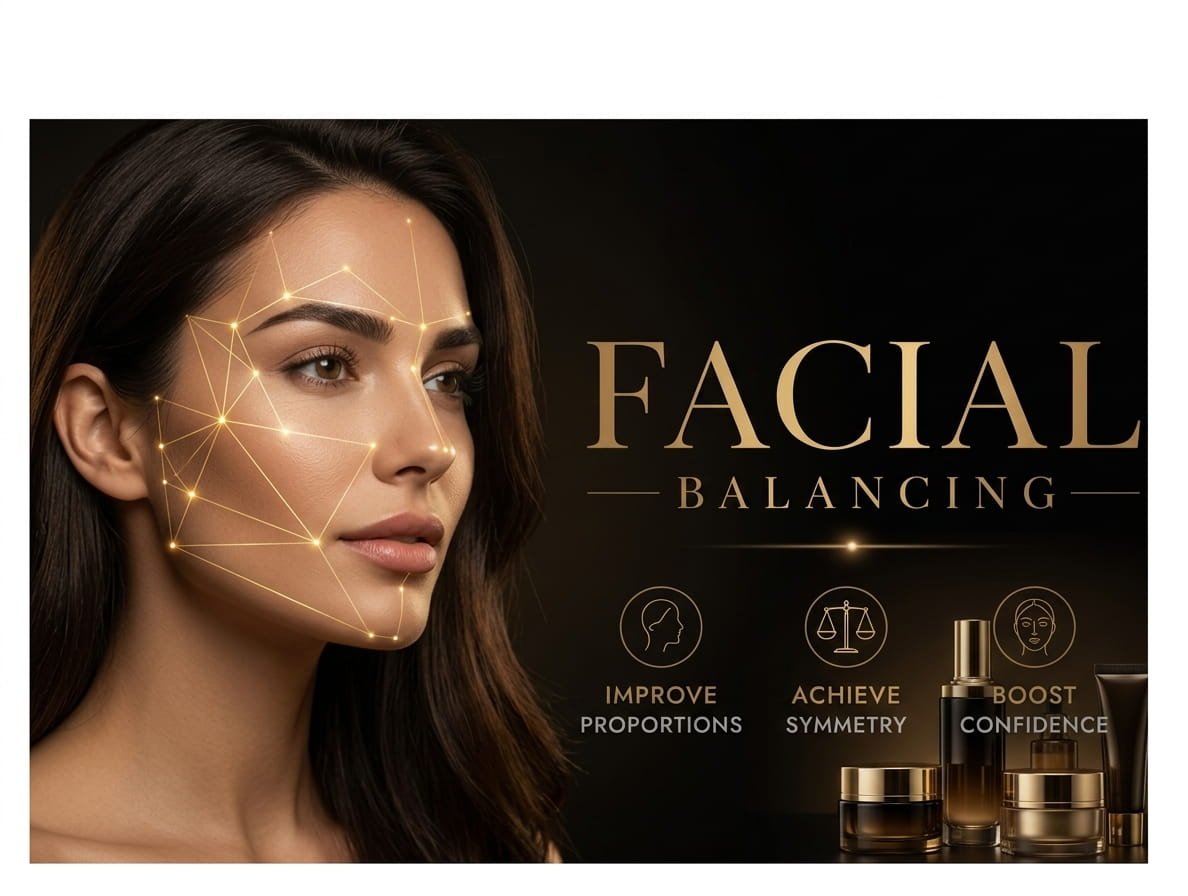
Facial balancing is a concept that many regard as a holistic approach to achieving harmony and proportion on the face. Instead of viewing the face in isolation, balancing focuses on the relationship and interaction between the facial features.
A person may notice that the nose seems too big, the chin is too small, the cheeks are flat, or the jawline lacks definition, among other issues. On an individual’s face, the problem may present differently. It can also be the combination or disproportion of several features rather than a single one.
Facial balancing usually focuses on enhancement and restoration of volume and structure to achieve subtle but noticeable improvement while still maintaining the individual’s unique facial characteristics. Depending on the individual’s case, facial balancing can involve dermal fillers, Botox or other neuromodulators, skincare, orthodontics, surgery, or a combination of several treatments.
This guide covers:
• A basic overview of facial balancing with some of the most common areas that may need adjustment
• An insight into what treatments are used and how they work
• A brief discussion on benefits, risks, costs, and results
• What to expect during a consultation, including a Q&A
What Is Facial Balancing?
Facial balancing is a concept that focuses on the harmony and proportion of the facial features and their relations to each other.
The face can be generally divided into thirds – the upper, middle, and lower thirds.
Each of these sections interacts with the other and makes up one’s facial structure as a whole. In some cases, addressing just one feature can restore the needed balance and proportion on the face. For example, adding volume to a recessive chin can improve the profile without any changes to the nose. Similarly, the middle third of the face can impact the lower third – a person who has lost volume in their cheeks may find that their lips also lost some fullness.
Facial balancing does not necessarily mean creating a perfectly symmetrical face – in fact, most people have slight differences on either side of their face. A balanced face is not about making one feature more dominant or prominent; instead, it is about achieving harmony and proportion while maintaining the individual’s uniqueness.
Why Is Facial Balance Important?
The appearance of the face is not determined by individual features; instead, it is mostly defined by the relationship between them.
The relative size, shape, projection, and volume of the nose, lips, cheekbones, chin, and jawline all contribute to the overall facial balance. For example, a small chin makes the nose look bigger in comparison, and a flat cheekbone can make the middle part of the face look sunken. On the other hand, overly prominent lower thirds can also ruin the balance and make the face look wider than it is.
Because of the complex interaction between different facial features, the correction of one area can impact several others. This is why simply highlighting the supposedly ”wrong” feature may not always give the desired result – a qualified professional can help determine the underlying cause of imbalance.
Facial Balancing vs. Facial Symmetry
Facial balancing should not be confused with facial symmetry. Symmetry is the correspondence in size, shape, and position of one half of the body with the other. In the context of the face, it means that both sides are roughly equal. Facial balancing, on the other hand, is the harmony and proportion of the different parts regardless of their position on the face. Ideally, both sides of the face are slightly asymmetrical but comparable in size and shape.
Common Areas of Facial Balancing
1. Nose
The nose, being the centerpiece of the face, has the most impact on the whole facial structure. Therefore, it is often the main concern, especially since the nose can look disproportionate to the rest of the face. For some people, their nasal bones or cartilage may be too wide, high, or low, have a bump or hump, or simply protrude too much. In cases like these, dermal fillers can be used to make subtle adjustments and correct some of the minor imperfections. However, it is important to note that fillers can only do so much in terms of reshaping the nose – and surgical options may be necessary.
2. Chin
The chin is the most notable feature on the side view of the face. A recessive chin makes the nose look bigger and broader while also making the face appear longer. In some cases, it can also make the lips look smaller by comparison. To fix this, the chin can be augmented to add volume and definition; dermal fillers can be used to add some projection in cases where surgery is undesired, although the results are only temporary.
3. Jawline
The jawline is the most projecting part of the face – and one of the most complex ones. Depending on the case, the jawline may appear too angular, weak, bulbous, or simply undefined. There are several reasons that can cause these issues, including genetics, significant weight loss, and even the natural process of aging. Several treatments, from dermal fillers to surgery, can be used to reshape the jawline and strengthen its definition. Neuromodulators and certain nonsurgical treatments may also be used to slim down a wide jawline by targeting the masseter muscle. The choice of the treatment depends on the cause, severity, and the individual’s personal preference.
4. Cheeks
The cheeks, along with the chin and lips, comprise the lower half of the middle third of the face. The volume and fullness of the cheeks affect the overall width and balance of the face – a person with a naturally wide face may find that their cheeks contribute to this, and want to reduce their volume. On the other hand, an aged or naturally narrow face may benefit from cheek augmentation. Similar to other nonsurgical treatments, dermal fillers are a popular option for adding volume to the cheeks. Although it is possible to make the face wider by filling the temples and upper part of the cheeks, overfilling can create an unnatural effect. The same goes for any other areas of the face.
5. Lips
Lips are a part of the lower third of the face – and one of its most defining features. Their shape and volume affect the balance and proportion of the whole face. The philtrum – the groove in the middle of the upper lip – also plays a crucial role in facial harmony. A qualified professional can help choose the most suitable option, such as lip fillers, to enhance the fullness of the lips without disrupting the balance and natural beauty of the mouth. It is important to note that overfilled lips can actually make the lower third look heavy and uneven.
6. Temples
The temples are the highest point on the face and one of its most defining features. A loss of volume in this area can make the face look sunken or older than it is. However, adding volume to the temples can also change the overall shape – especially the upper third. In cases where the temples are too narrow, the upper part of the forehead may also decrease in volume. However, it is important to be careful when applying fillers to this area, as the temples contain vital structures such as the temporal artery. Any treatment should be performed by a qualified and experienced professional.
7. Forehead and Brows
The forehead is the biggest part of the face and sets its overall shape and size. Along with the brows, it comprises the upper third. Although the forehead itself rarely needs correction, there may be cases when nonsurgical treatments – such as neuromodulators – can be used to reduce the heaviness and tension on the forehead and weaken some of the prominent muscles. These treatments can also be used to subtly adjust the shape and position of the brows. As with most other procedures, a consultation with a professional is necessary before undergoing any treatments, as overly strong injections can cause the brows to migrate.
Facial Balancing With Dermal Fillers
Dermal fillers are one of the most versatile and popular tools for facial balancing. They can be used almost anywhere on the face – depending on the desired effect and results. In some cases, fillers can help restore the lost volume; in others, they can be used to change the projection and definition of specific areas. Hyaluronic acid fillers, in particular, are known for their reliability, versatility and safety – they can be easily dissolved with hyaluronidase solution if needed.
Although some people may believe that more syringes equal more volume and a better result, the amount of filler needed to achieve a good balance is actually highly individual. It is better to choose the most suitable treatment based on the individual’s anatomy rather than the number of syringes.
Facial Balancing With Botox
Botulinum toxin, or Botox, works differently than dermal fillers. While the latter are used for reshaping, volumizing, and enhancing the facial features, Botox temporarily reduces muscle activity. Neuromodulators can be used in several areas to achieve facial balancing.
Depending on the individual’s case, Botox or other similar treatments can be used to:
• Reduce wrinkles on the forehead and around the eyes
• Weaken prominent muscles on the brows
• Reduce the size of the masseter muscle in the jaw area
• Target certain areas on the lower third of the face, such as the corners of the mouth
It is important to note that Botox is not a filler – therefore, it cannot add volume to specific areas.
Facial Balancing Without Injectables
Although dermal fillers and neuromodulators are often the easiest and most effective way to achieve facial balancing, there are other nonsurgical treatments available. They might be recommended in certain cases or used in combination with injectables for a longer-lasting result. Some of the popular nonsurgical treatments for facial balancing include:
• Skincare, including microdermabrasion and chemical peels
• Makeup and contouring
• Orthodontics or other dental treatments
• Weight loss, in cases where excess weight affects facial structure and balance
• Hair styling and eyebrow shaping
• Treatments for pigmentation, acne, and other blemishes
In some cases, maintaining proper skincare can even be more beneficial than adding extra volume with fillers.
Surgical Balancing
In some cases, especially when there is a structural deformity causing the imbalance, facial balancing may include surgery. A qualified professional will be able to identify such cases and recommend the treatment. Some of the possible surgical procedures for facial balancing include:
• Nose surgery (rhinoplasty)
• Chin or jaw implants or surgery
• Orthognathic surgery (jaw surgery)
• Facelift or neck lift
• Blepharoplastics (eyelid surgery)
Surgery is usually a more invasive and expensive option, and it will be considered only when nonsurgical treatments are inadequate.
Facial Balancing for Different Face Shapes
Facial balancing is highly individual and depends on several factors. There are several major shapes that may have certain characteristics and require specific treatments, although an individual may have a combination of several.
Oval Face
An oval face is generally considered to be one of the most balanced shapes – and may not require major correction. However, each individual case should be considered individually.
Round Face
A Round face shape, as the name suggests, implies that the face is generally circular. People with round face shapes often want to balance the width of the chin and jawline and reduce the overall roundness. It is important to note that not all round faces have wide jaws – in some cases, the temples or cheeks may be the ones contributing to the roundness.
Square Face
A square face, similarly to a round one, has a broad lower third and a narrow upper third. However, unlike the round face, this one has a generally squareshaped jawline.
Long Face
This face shape implies that the face is longer than it is wide. People with long face shapes often seek ways to make their face look shorter by making the lower third bigger or the upper part smaller.
HeartShaped Face
A heartshaped face is generally wider at the upper third and narrows down to the chin. Long and narrow chins, in particular, may benefit from augmentation to create a more balanced look.
Benefits of Facial Balancing
Some of the benefits of facial balancing include:
• Harmonious proportions of the face
• An improved facial structure and silhouette
• Added volume in certain areas
• Restored lost volume or definition
• A better profile
• Youthful appearance with a natural look
• Boosted self-confidence and satisfaction with the facial appearance
It is important to note that facial balancing should not aim to make someone look entirely different. Instead, the focus should be on subtle enhancement and achieving the most natural appearance.
How to Make Sure Facial Balancing Looks Natural?
To achieve a natural appearance, it is important to focus on subtle enhancement rather than dramatic changes. One of the most common mistakes is to try to make one particular feature stand out – such as the lips, chin, or cheeks. In most cases, it is better to make small improvements rather than try to make one feature bigger.
When done in moderation, facial balancing can actually make the face look more defined and attractive. A good professional will be able to determine the areas that need subtle enhancement based on the individual’s facial structure, symmetry, and other characteristics, such as age and skin type.
What Happens During a Facial Balancing Consultation?
A consultation with a professional should always start with an evaluation rather than jumping to treatment. The professional will analyze the individual’s facial structure, symmetry, and skin condition to develop a customized plan.
The following points will be taken into consideration:
• Overall facial structure and symmetry
• The condition of the skin and the bone structure underneath
• The amount of volume in the cheeks and chin
• The projection and shape of the jawline
• The position and shape of the nose in relation to the chin
• The balance and proportions of the lips
• The activity level of the major muscles on the face
• The signs of aging
It is important to take photos from different angles to ensure the accuracy of the plan. Additionally, a professional will be able to explain the risks, the expected recovery time, and alternative treatments and procedures.
What Is a Good Candidate for Facial Balancing?
A good candidate for facial balancing is an individual that:
• Has realistic expectations
• Understands that the results are highly dependent on the personal anatomy
• Seeks subtle enhancement rather than dramatic change
• Is physically well enough to endure the procedure
• Is aware of the potential risks and complications
• Has a particular concern that can be addressed during the procedure
It is also important to remember that not every individual requires facial balancing – in some cases, other treatments or no treatment at all may be the best option.
Is Facial Balancing Safe?
The safety of facial balancing depends on the type of procedure and the skill of the professional performing it. Most injectable procedures, for example, will only have temporary side effects, such as swelling, bruising, redness, and dryness. In some cases, the injection site may also be itchy or sensitive for the first few days.
The more permanent and serious side effects are rare but possible – it is important to choose a qualified and experienced professional when considering facial balancing. For example, dermal fillers can potentially block the blood circulation. This is a serious complication that requires immediate medical attention and may cause vision impairment or other dangerous side effects.
How Long Does Facial Balancing Take?
The actual duration of the procedure highly depends on the type and number of treatments. In most cases, nonsurgical facial balancing takes relatively little time, especially when compared to surgery. On the other hand, a treatment plan that covers multiple areas may take significantly longer.
Filler treatments, for example, can provide immediate results, although the individual may experience some mild swelling or bruising. On the other hand, Botox and other neuromodulators take longer to show visible results.
Surgical procedures require more extensive planning and a longer recovery.
How Long Do Facial Balancing Results Last?
The duration of results also highly depends on the type of procedure. Filler treatments, for example, can last for a few months or even several years, depending on the type and amount of filler, individual metabolism, and other factors.
Botox generally provides a temporary reduction of muscle activity for several months. Surgical procedures, on the other hand, generally have permanent results, although the face will continue to age naturally. Another important point to consider is the patient’s lifestyle – in particular, the impact of smoking, alcohol consumption, and sun exposure on the skin.
Before and After Facial Balancing Photos
Facial balancing before and after photos are an essential part of the consultation – however, it is important to understand what the individual should be looking for in them. When reviewing such photos, the individual should pay attention to whether the example patient has a similar facial structure and consult the professional about their concerns.
It is also important to remember that lighting, makeup, facial expressions, the camera angle, and other factors can affect the final image.
Cost of Facial Balancing
The cost of facial balancing highly depends on the individual’s anatomy, the number of areas that need correction, and the type of treatment. A single syringe of filler, for example, generally ranges from
to
, depending on the brand, the experience of the professional, and the location.
However, a consultation with a professional is essential to developing a personalized treatment plan. Additionally, it is important not to choose the cheapest option first, especially when it comes to facial injectables – experience and expertise are crucial when choosing a professional.
Aftercare Following Facial Balancing
The aftercare instructions vary depending on the treatment – most procedures only require the patient to avoid touching the injection site and limit UV exposure as much as possible. Surgical procedures, on the other hand, require a longer period of healing and additional instructions from the professional.
If the individual experiences any concerning side effects after the procedure, they should contact the professional and seek medical attention if necessary.
Common Mistakes To Avoid
Some of the most common mistakes when it comes to facial balancing include:
1. Trying To Treat Too Many Areas At Once
Not every facial feature should be emphasized – in some cases, an attempt to make the face look bigger or wider can end up making it look unnatural.
2. Going For Absolute Symmetry
While most people strive for a perfectly symmetrical face, it is important to note that absolute symmetry is almost impossible to achieve.
3. Buying Too Much Product
The amount of filler needed to achieve a good result is highly individual – and trying to buy more than needed, or exceeding the recommended amount, can lead to a wider, puffier face that looks unnatural.
4. Trying To Save Money By Using Inexperienced Professionals
While it might seem like a good idea to go for a cheaper facelift, it is important to understand the risks that come with it. Inexperienced professionals may also hide their lack of skills with marketing tactics, such as promising unrealistic results.
5. Overlooking The Other Parts Of The Face
Focusing on one particular area, such as the lips, may fail to address the real issue.
Conclusion
Facial balancing can help achieve a subtle but noticeable improvement on the face by emphasizing some of the key features and restoring the balance and harmony between different facial parts. The most important part is to set realistic expectations and choose an experienced professional that will be able to recommend the most suitable treatment. A consultation is essential for every individual, as the facial structure and desired outcome play the biggest role in determining the final results.
Frequently Asked Questions(FAQs)
1. What is facial balancing?
Facial balancing is an aesthetic concept that focuses on the relationship between different facial features.
2. Is facial balancing and facial symmetry the same thing?
No, they are not. Facial symmetry is about the relationship between the left and right sides of the face, whereas facial balancing is about the relationship between the different features.
3. Can fillers be used for facial balancing?
Yes, they can. Fillers can be used on any part of the face to enhance and restore the balance.
4. Can Botox help with facial balancing?
Botox can be used for facial balancing in certain cases by reducing muscle activity, although it cannot restore the volume.
5. Does facial balancing permanently change your face?
Facial balancing is usually a nonsurgical procedure, meaning that the results are only temporary.
6. How much does facial balancing cost?
The cost greatly varies between different individuals, areas, and procedures.
7. Is facial balancing painful?
Most procedures only have minimal discomfort associated with them and a short recovery time.
8. How long do facial balancing results last?
It highly depends on the type of the procedure, but most nonsurgical treatments last for several months or more. Surgical procedures, on the other hand, are generally permanent.
9. Is facial balancing safe?
Most procedures are relatively safe when done by an experienced and qualified professional. However, it is important to understand that every treatment, especially those involving injectables, carries certain risks.
10. Who should consider facial balancing?
Individuals that are unhappy with their appearance should consult with a professional to discuss the possible options.
A qualified professional will be able to identify the cause of the concern and recommend the treatment.