Bio Oil Review: Benefits, Uses, Side Effects & How to Use
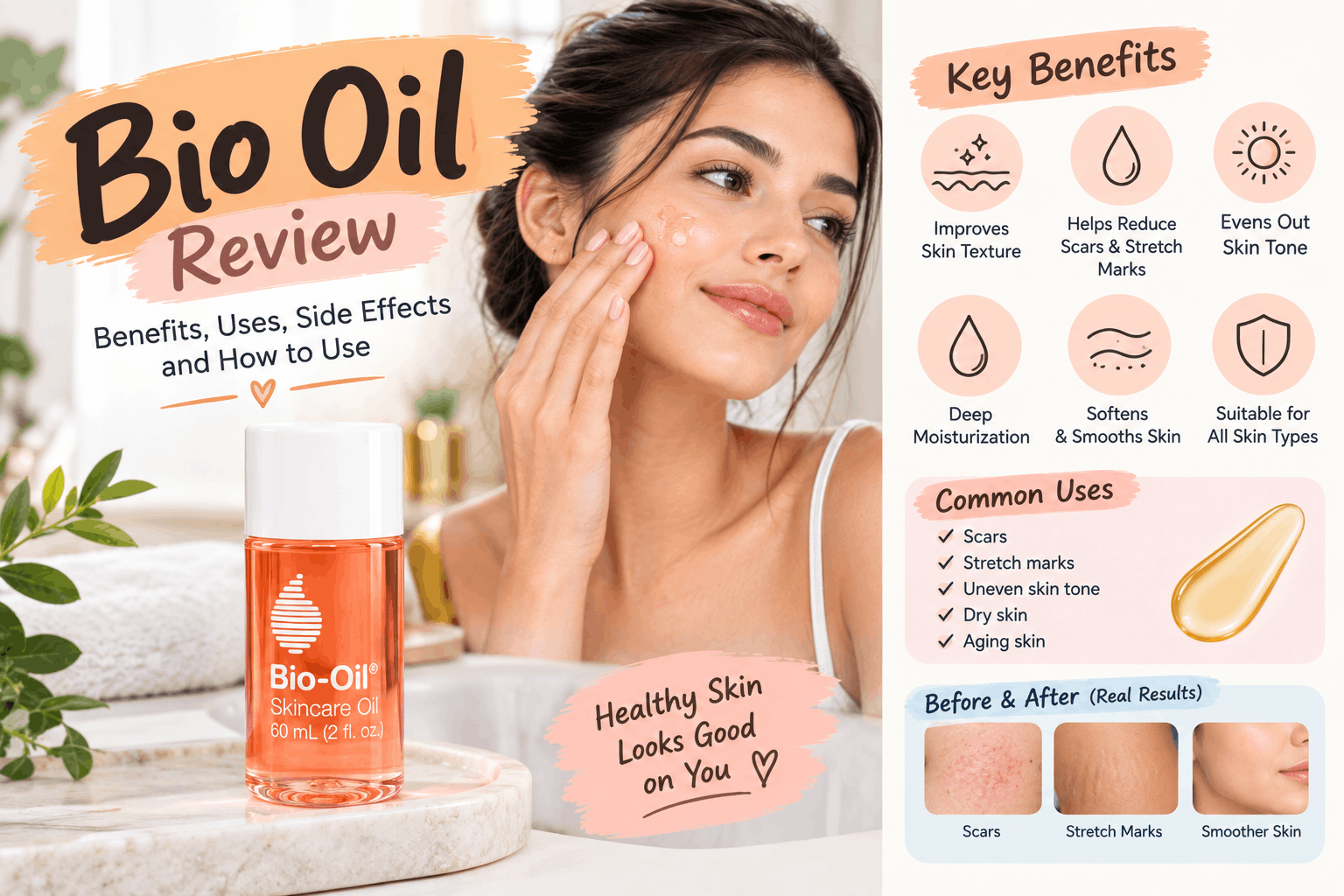
Bio Oil is a popular skincare oil used by people who want to improve the appearance of scars, stretch marks, uneven skin tone, and dry skin. Its lightweight oil texture makes it easy to massage into the skin, which is one reason it has remained a popular body-care product.
But does Bio Oil actually work? The answer depends on what you want it to do. It can help moisturize and soften the skin, while regular massage and hydration may make some areas look smoother. However, claims that a cosmetic oil can completely remove established scars or stretch marks should be viewed cautiously. Dermatology research shows that stretch marks are difficult to treat and that no single topical product works consistently for everyone.
What Is Bio Oil?
Bio Oil is a cosmetic skincare oil designed primarily for improving the appearance and feel of the skin. It is commonly marketed for scars, stretch marks, uneven skin tone, and dry skin.
The product is applied directly to the skin and massaged in. Its oily texture creates an emollient effect, helping the skin feel softer and smoother.
It is important to understand that a cosmetic product can improve the appearance and texture of skin without actually eliminating a scar or changing the underlying structure responsible for a stretch mark.
Bio Oil Ingredients
The formulation of Bio Oil contains a combination of oils and other skincare ingredients intended to condition the skin.
Depending on the specific Bio-Oil formulation and country, ingredients can vary, so consumers should check the packaging of the product they purchase.
Commonly discussed components include:
- Mineral oil
- Plant-derived oils
- Vitamin E
- Vitamin A
- Fragrance
- PurCellin Oil technology
These ingredients contribute to the product’s emollient and moisturizing properties.
If you have sensitive skin or known allergies, reading the complete ingredient list is particularly important before applying the product.
Bio Oil Benefits
1. Helps Moisturize Dry Skin
One of the most straightforward benefits of a body oil is improving the feel of dry skin.
Oil-based products can reduce moisture loss from the skin and leave the surface feeling smoother and more supple.
For people with dry areas on the legs, arms, abdomen, or other parts of the body, Bio Oil can therefore function primarily as a conditioning skincare product.
2. Softens Rough Skin
Regular application can make rough or dry areas feel softer.
This effect is different from permanently changing the structure of the skin, but improved hydration can make the surface look healthier.
3. May Improve the Appearance of Scars
Bio Oil is commonly used on scars, but expectations should remain realistic.
Scars naturally change over time as they mature. Keeping the surrounding skin moisturized and massaging the area may make the skin feel more comfortable and supple, but cosmetic oils should not be considered a guaranteed scar-removal treatment.
Research on topical oils and scar appearance has produced mixed results, and evidence varies considerably between different formulations.
4. May Improve the Appearance of Stretch Marks
Stretch marks are a form of dermal scarring caused by stretching of the skin. They commonly develop during pregnancy, puberty, rapid weight changes, or other periods of significant skin stretching.
Some studies of topical oil formulations have reported improvements in the appearance of stretch marks, but the evidence is not strong enough to conclude that a particular cosmetic oil will reliably remove them.
5. Gives Skin a Smoother Appearance
Because oils can temporarily smooth the skin surface and increase its softness, the treated area may look more hydrated and polished after application.
This cosmetic effect should not be confused with permanent scar correction.
Does Bio Oil Remove Stretch Marks?
This is one of the most common questions about the product.
Bio Oil may help improve the appearance and softness of the skin, but it should not be described as a proven way to completely remove stretch marks.
Stretch marks are a type of scar. According to the American Academy of Dermatology, treatments may make stretch marks less noticeable, but they do not completely eliminate them. Research also shows that treatment outcomes vary considerably between people.
A 2026 systematic review found that several treatments, including certain topical and procedural options, may improve stretch marks, but the available evidence remains variable and no single treatment can be considered universally effective.
Does Bio Oil Remove Scars?
Bio Oil may improve how the skin feels and may make some scars appear less dry or noticeable, but it cannot guarantee scar removal.
The outcome depends on factors such as:
- Type of scar
- Age of the scar
- Location
- Size
- Skin type
- Original injury
- Individual healing process
Raised scars, depressed scars, surgical scars, acne scars, and stretch marks can behave very differently.
If a scar is particularly prominent or bothersome, a dermatologist can recommend evidence-based options according to its type.
Bio Oil for Dry Skin
Dry skin is one area where an oil-based product can be useful.
Applying an emollient after bathing can help reduce the feeling of dryness and leave the skin smoother. For particularly dry skin, however, a fragrance-free cream or ointment may be preferable for some people.
It can be incorporated into a moisturizing routine if the skin tolerates it well.
Bio Oil for Uneven Skin Tone
Bio Oil is also marketed for improving uneven skin tone.
However, uneven pigmentation has many possible causes, including sun exposure, inflammation, acne, hormonal changes, and certain skin conditions.
An oil should not be expected to correct every form of hyperpigmentation.
For persistent dark spots, sunscreen and targeted dermatological treatments are generally more relevant than relying on a cosmetic oil alone.
How to Use Bio Oil
Using the product consistently is more important than applying a large amount.
Step 1: Clean the Skin
Apply the oil to clean skin.
Step 2: Use a Small Amount
A small quantity is generally sufficient. Too much oil can leave the skin excessively greasy.
Step 3: Massage Gently
Massage the product into the desired area using gentle circular movements.
Avoid aggressive rubbing, particularly on recently injured or irritated skin.
Step 4: Allow It to Absorb
Give the product time to absorb before putting on clothing.
Step 5: Use Consistently
If you are using it for cosmetic improvement, regular use over time is more realistic than expecting immediate results.
How Often Should You Use Bio Oil?
Follow the instructions on the specific product packaging.
Many users incorporate body oils into their routine once or twice daily, but the ideal frequency depends on skin tolerance and the purpose of use.
If irritation develops, reduce use or discontinue the product.
When Should You Apply Bio Oil?
Bio Oil can be applied after bathing when the skin has been gently dried.
Some people prefer applying an oil after a moisturizer, while others use it alone. The best approach depends on how dry your skin is and how the product feels on your skin.
For very dry skin, using a moisturizing cream first and an oil afterward may provide more comprehensive hydration.
Bio Oil for Pregnancy
Pregnancy is one of the most common reasons people look for products for stretch marks.
However, preventing stretch marks is difficult, and research has not established that topical preparations reliably prevent them. A Cochrane review of topical preparations during pregnancy found no statistically significant overall reduction in stretch-mark development compared with placebo or no treatment.
If you are pregnant, check the ingredient list of any skincare product with your healthcare professional, particularly if it contains vitamin A derivatives or other ingredients that may not be appropriate during pregnancy.
The American Academy of Dermatology also recommends checking with a doctor before treating stretch marks during pregnancy or breastfeeding because some products contain retinoids that can be harmful to a baby.
Bio Oil Side Effects
Bio Oil is tolerated by many people, but no skincare product is suitable for everyone.
Possible problems may include:
- Skin irritation
- Redness
- Itching
- Burning or stinging
- Fragrance sensitivity
- Breakouts in acne-prone individuals
If you develop persistent irritation, stop using the product and allow your skin to recover.
People with sensitive skin may want to test a small area first.
Is Bio Oil Good for Acne-Prone Skin?
This depends on the individual.
Because Bio Oil is an oil-based cosmetic product and may contain fragrance, some people with acne-prone or sensitive skin may prefer lighter, non-comedogenic moisturizers.
It is generally better suited to areas such as the body than as a first-choice facial treatment for acne-prone skin.
If you are using it on your face, patch testing is sensible, particularly if you frequently experience breakouts or irritation.
Can You Use Bio Oil on Your Face?
Some people use Bio Oil on facial skin, but whether it is appropriate depends on your skin type and the formulation.
If your skin is oily, acne-prone, rosacea-prone, or sensitive to fragrance, a dedicated facial moisturizer may be a better option.
For facial pigmentation, acne scars, or persistent discoloration, targeted dermatological products may provide more meaningful results.
Bio Oil vs. Moisturizer
Bio Oil and a traditional moisturizer can serve different purposes.
A moisturizer is generally formulated to hydrate and support the skin barrier, while an oil mainly provides emollient and occlusive properties.
For dry skin, you do not necessarily have to choose one or the other. Some people use a cream or lotion and then apply a small amount of oil over it to help reduce moisture loss.
Does Bio Oil Work Overnight?
It is unlikely that a single overnight application will dramatically change a scar or stretch mark.
Skin appearance changes gradually. If a topical product provides a visible cosmetic benefit, it generally requires consistent use rather than one-time application.
Be especially skeptical of claims promising complete scar removal within a few days.
How Long Does Bio Oil Take to Work?
There is no universal timeline.
The appearance of scars and stretch marks naturally changes over months, making it difficult to attribute every improvement to a particular product.
If you are using Bio Oil, assess your skin over several weeks rather than expecting dramatic changes within a few days.
The American Academy of Dermatology notes that topical treatments for stretch marks, when effective, generally require consistent application over weeks, and mature stretch marks tend to respond less readily than newer ones.
Who Should Avoid Bio Oil?
Consider avoiding or discussing use with a healthcare professional if:
- You have a known allergy to an ingredient.
- Your skin is actively irritated.
- You have an open wound.
- You develop a reaction after application.
- You are pregnant or breastfeeding and are unsure about an ingredient.
- You have a diagnosed skin condition requiring medical treatment.
Do not use cosmetic oil as a substitute for proper wound care on fresh injuries.
What Does the Research Say About Oils and Stretch Marks?
The evidence deserves a balanced interpretation.
A controlled study of a plant-oil cosmetic formulation reported improvement in the appearance of scars and stretch marks after eight weeks. However, that study examined a particular oil blend and does not establish that every cosmetic oil—or Bio Oil specifically—will produce the same results.
Other research shows that stretch-mark treatments overall have inconsistent evidence. A 2024 systematic review concluded that several treatment approaches have been studied, but outcomes vary and more evidence is needed.
A 2026 review similarly found that treatment remains challenging and that results depend on the type of stretch mark and treatment used.
Therefore, the most reasonable way to view Bio Oil is as a cosmetic skin-conditioning product that may improve the appearance and feel of the skin, rather than a guaranteed scar-removal treatment.
Pros and Cons of Bio Oil
Pros
- Easy to apply
- Helps soften dry skin
- Can make skin feel smoother
- Useful as part of a body-care routine
- Convenient for massage
- May improve the cosmetic appearance of some areas
Cons
- Does not guarantee scar removal
- Stretch-mark evidence is limited and mixed
- May not suit sensitive or acne-prone skin
- Fragrance may irritate some users
- Results can take time
- More significant scars may require professional treatment
Final Verdict: Is Bio Oil Worth It?
Bio Oil can be a reasonable choice if your main goal is to soften, condition, and moisturize the skin.
For scars and stretch marks, expectations should be more conservative. There is some research suggesting that topical oil formulations can improve the appearance of certain scars or stretch marks, but broader dermatology evidence does not support the idea that cosmetic oils can completely eliminate these marks.
If you enjoy the texture and your skin tolerates it, Bio Oil can be part of a regular body-care routine. But if your main concern is a significant scar, persistent pigmentation, or established stretch marks, a dermatologist can discuss treatments with stronger evidence for the specific condition.
Conclusion
Bio Oil is best viewed as a cosmetic skincare oil rather than a miracle treatment for scars or stretch marks. It can help moisturize dry skin, improve softness, and give the skin a smoother appearance.
Its use for scars and stretch marks is more complicated. Research on topical oils shows some promising findings, but evidence across stretch-mark treatments remains inconsistent, and established marks cannot simply be erased with an over-the-counter oil.
For the best results, use Bio Oil consistently if your skin tolerates it, maintain realistic expectations, and consider professional dermatological advice when dealing with persistent scars, significant pigmentation, or troublesome stretch marks.
Frequently Asked Questions
1. What is Bio Oil used for?
Bio Oil is primarily used as a cosmetic skincare oil to moisturize and condition the skin and improve the appearance of scars, stretch marks, and uneven-looking skin.
2. Does Bio Oil really remove scars?
No cosmetic oil can guarantee complete scar removal. Bio Oil may make some scars look or feel smoother, but significant scars may require professional treatment.
3. Can Bio Oil remove stretch marks?
Bio Oil may improve the appearance and softness of stretch-marked skin, but it should not be expected to completely remove stretch marks. Dermatology evidence shows that stretch marks are difficult to treat and that no single treatment works for everyone.
4. Can I use Bio Oil every day?
If your skin tolerates it, Bio Oil can be incorporated into a regular skincare routine. Follow the instructions on the specific product and stop if irritation develops.
5. Is Bio Oil good for dry skin?
Yes. Its oil-based formulation can help condition dry skin and leave it feeling softer and smoother.
6. Can I use Bio Oil on my face?
Some people do, but it may not be ideal for everyone, particularly people with oily, acne-prone, or sensitive skin. A facial moisturizer formulated for your skin type may be a better option.
7. Is Bio Oil safe during pregnancy?
Pregnant people should check the ingredient list and discuss skincare products with their healthcare professional, especially when vitamin A derivatives or other potentially unsuitable ingredients are involved.
8. How long does Bio Oil take to work?
There is no guaranteed timeline. Cosmetic changes, particularly involving scars or stretch marks, generally require consistent use over weeks or longer, and results vary between individuals.
9. Can Bio Oil cause acne?
It may not suit everyone with acne-prone skin. If you notice clogged pores, breakouts, redness, or irritation after using it, discontinue the product and choose a skincare product better suited to your skin type.
10. What is better than Bio Oil for stretch marks?
The best option depends on whether the stretch marks are new or mature, their color, skin type, and your goals. Dermatologists may consider treatments such as prescription topical therapies or procedures including laser, radiofrequency, or microneedling. No treatment guarantees complete removal.