15 Skin Rejuvenation Treatments for Radiant -Looking Skin
Healthy-looking skin naturally changes with age, sun exposure, hormones, lifestyle, and environmental stress. Fine lines, uneven pigmentation, dullness, enlarged pores, rough texture, acne scars, and loss of firmness can gradually become more noticeable.
The good news is that modern dermatology and aesthetic medicine offer many skin rejuvenation treatments designed to improve the appearance of these concerns. Options range from gentle facials and exfoliation to chemical peels, microneedling, lasers, light-based treatments, radiofrequency procedures, and injectables.
There is no single treatment that is best for everyone. The right option depends on your skin type, specific concern, medical history, desired results, budget, and how much downtime you can manage.
What Is Skin Rejuvenation?
Skin rejuvenation is a broad term used for cosmetic treatments that aim to improve the appearance of the skin.
Depending on the procedure, rejuvenation may target:
- Fine lines and wrinkles
- Uneven skin tone
- Sun-related pigmentation
- Dull-looking skin
- Rough texture
- Acne scars
- Enlarged pores
- Visible redness
- Loss of firmness
- Facial volume changes
Some treatments work mainly on the surface of the skin, while others target deeper tissue. Microneedling, for example, creates controlled micro-injuries that stimulate the body’s healing response and collagen production.
Because these procedures work differently, choosing a treatment based on your specific concern is more useful than simply choosing the newest or most expensive option.
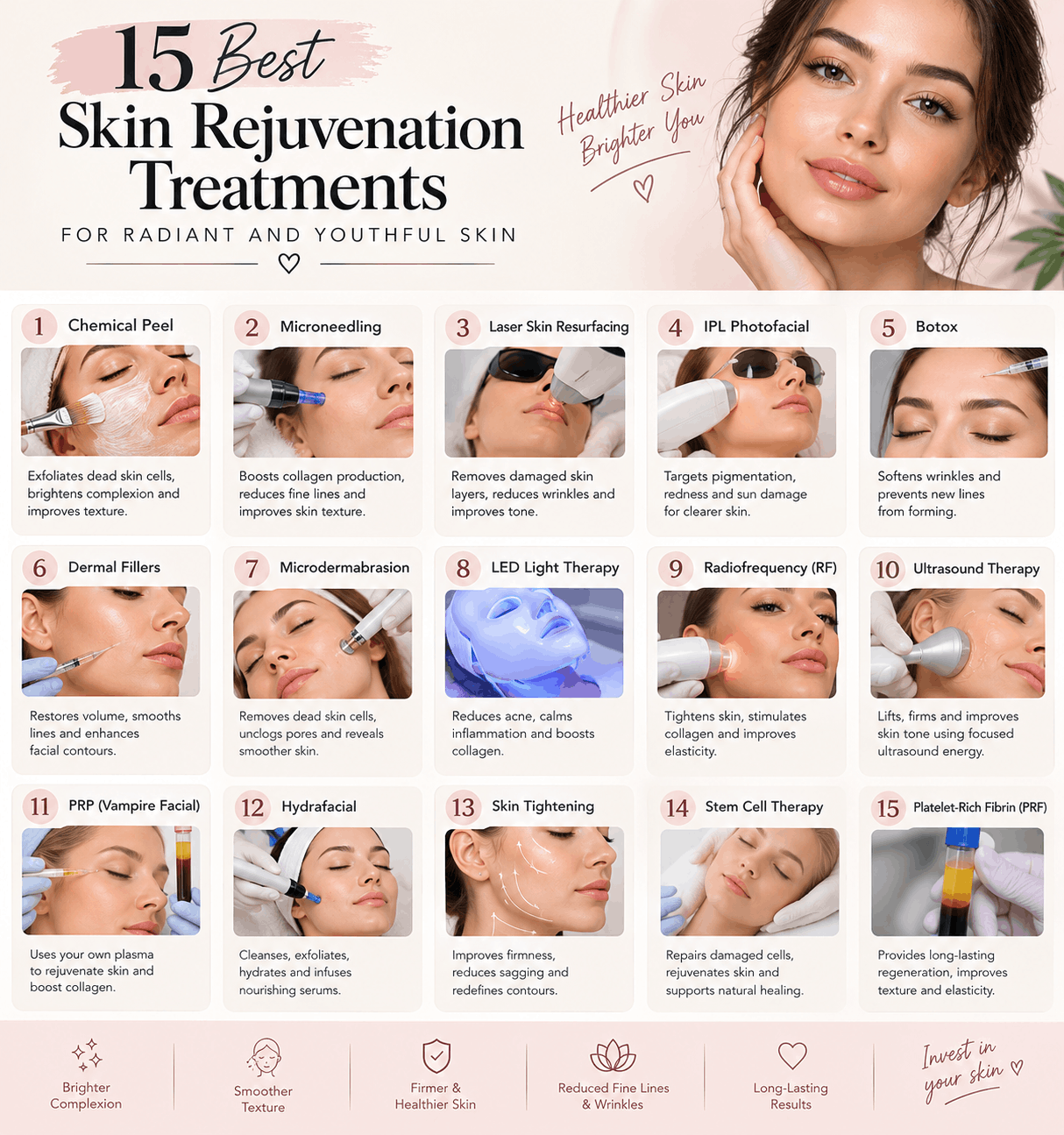
15 Best Skin Rejuvenation Treatments
1. Chemical Peels
Chemical peels use a carefully selected chemical solution to exfoliate the skin. Depending on the type and strength, a peel can target superficial or deeper layers.
Dermatologists may use chemical peels to improve the appearance of:
- Fine lines
- Uneven pigmentation
- Dullness
- Rough texture
- Certain types of acne
- Sun damage
- Some forms of discoloration
The American Academy of Dermatology notes that chemical peels can produce smoother skin, a brighter complexion, and more even-looking skin color.
Peels vary considerably in strength, so stronger does not automatically mean better.
2. Microneedling
Microneedling is a minimally invasive procedure that uses tiny needles to create controlled punctures in the skin.
The healing process can stimulate collagen production and improve the appearance of certain scars, uneven texture, wrinkles, and other concerns. The AAD describes microneedling as an option for acne scars, wrinkles, enlarged pores, uneven tone, melasma, and other texture concerns.
Results are usually gradual rather than immediate, and some people require multiple sessions.
The FDA recommends having medical microneedling performed by a properly trained healthcare provider because complications can include infection, pigmentation changes, bleeding, bruising, and skin damage.
3. Laser Skin Resurfacing
Laser resurfacing uses concentrated laser energy to treat targeted areas of the skin.
Depending on the technology, lasers can remove controlled amounts of the outer skin layer or stimulate changes in deeper tissue.
Laser resurfacing may be considered for concerns such as:
- Fine lines
- Uneven texture
- Certain scars
- Sun-related changes
- Some pigmentation concerns
Ablative lasers are generally more intensive because they remove portions of the outer skin, while non-ablative approaches work without removing the entire surface.
Because laser technologies differ substantially, treatment settings should be selected according to skin type and the concern being treated.
4. Intense Pulsed Light Therapy
Intense pulsed light, commonly called IPL, uses broad-spectrum pulses of light rather than a single laser wavelength.
Depending on the device and individual skin characteristics, IPL may be used to improve the appearance of:
- Sun spots
- Freckles
- Certain types of redness
- Uneven-looking skin tone
IPL is not appropriate for every skin type or every pigmentation concern. Incorrect treatment settings can increase the risk of burns or unwanted pigment changes.
A professional assessment is therefore important before treatment.
5. Radiofrequency Skin Tightening
Radiofrequency treatments use energy to heat tissue beneath the skin’s surface.
These procedures are commonly used to improve the appearance of skin firmness and texture. Depending on the technology, treatment may be non-invasive or involve needles.
Results vary between devices and individuals, and several sessions may be recommended.
Important RF Microneedling Safety Note
RF microneedling is different from conventional microneedling because it combines needles with radiofrequency energy.
The FDA issued a safety communication in October 2025 warning about reported serious complications associated with certain uses of RF microneedling, including burns, scarring, fat loss, disfigurement, and nerve damage.
Anyone considering this treatment should discuss the specific device, provider qualifications, expected benefits, and risks before proceeding.
6. Microdermabrasion
Microdermabrasion is a mechanical exfoliation procedure that removes some of the outermost dead skin cells.
It is generally less intensive than many resurfacing procedures and may be used to improve the appearance of:
- Dull skin
- Mild uneven texture
- Roughness
- Certain superficial cosmetic concerns
Because it typically involves less downtime than more aggressive resurfacing, some people choose it as a gentler cosmetic option.
7. Dermabrasion
Dermabrasion is more intensive than microdermabrasion.
It uses specialized equipment to remove controlled layers of the skin and may be considered for certain scars, texture irregularities, and other cosmetic concerns.
Because it is a more aggressive procedure, professional evaluation and careful aftercare are especially important.
8. Hydrafacial-Style Treatments
Hydrafacial is a branded multi-step treatment that combines cleansing, exfoliation, extraction, and hydration.
These treatments are often chosen by people who want a refreshed and smoother-looking complexion without the recovery associated with more aggressive resurfacing.
The exact treatment protocol can vary between providers, so it is worth asking what steps and products will actually be used during the appointment.
9. Anti-Wrinkle Injections
Botulinum toxin injections are another category of cosmetic rejuvenation.
Unlike resurfacing treatments, these injections primarily affect targeted facial muscles. They can temporarily soften the appearance of certain dynamic wrinkles caused by repeated muscle movement.
Common treatment areas may include:
- Forehead lines
- Frown lines
- Crow’s feet
They do not directly correct every sign of skin aging, such as pigmentation, rough texture, or significant volume loss.
The AAD lists botulinum toxin among established cosmetic options for certain facial wrinkles.
10. Dermal Fillers
Dermal fillers are injectable products used to add or restore volume in selected facial areas.
Depending on the product and treatment area, fillers may be used to improve the appearance of:
- Facial volume loss
- Certain folds
- Hollow areas
- Facial contours
- Some lines associated with volume changes
Fillers and anti-wrinkle injections work differently. Fillers primarily address volume, while botulinum toxin targets muscle activity.
Because fillers are injected beneath the skin, provider experience and knowledge of facial anatomy are particularly important.
11. LED Light Therapy
LED light therapy uses specific wavelengths of light for cosmetic and dermatologic purposes.
Different wavelengths are used for different goals, and results depend on the device, treatment schedule, and skin concern.
LED treatments are generally considered less invasive than procedures that break the skin, making them attractive to people who want an option with little downtime.
However, expectations should remain realistic. A gentle light-based treatment should not be considered equivalent to intensive laser resurfacing or other medical procedures.
12. Platelet-Rich Plasma Treatments
Platelet-rich plasma, commonly called PRP, involves processing a person’s own blood to concentrate platelets and then using the resulting preparation in an aesthetic or medical procedure.
PRP has received attention in cosmetic dermatology, including facial rejuvenation.
However, evidence and treatment protocols vary depending on the specific use. It should not be treated as a guaranteed solution for aging or skin damage.
Anyone considering PRP should discuss the evidence, expected results, risks, and alternatives with a qualified medical professional.
13. Professional Facial Treatments
Professional facials can provide cleansing, exfoliation, hydration, and other cosmetic benefits.
Depending on the treatment, a facial may include:
- Cleansing
- Gentle exfoliation
- Steam
- Extraction
- Hydrating products
- Masks
- Massage
Facials are generally less intensive than medical resurfacing procedures and may be useful for maintaining a refreshed appearance.
However, they should not be expected to produce the same type of collagen remodeling or resurfacing effects associated with procedures such as laser treatments or microneedling.
14. Skin-Firming Ultrasound Treatments
Certain aesthetic ultrasound technologies use focused energy beneath the skin to target tissue at specific depths.
These treatments are marketed for improving the appearance of skin firmness and contour.
The results, treatment depth, recovery, and suitability vary according to the device and individual.
As with any energy-based procedure, ask the provider exactly which technology is being used and whether it is appropriate for your skin and treatment goals.
15. Combination Skin Rejuvenation
Sometimes a single procedure cannot address every cosmetic concern.
A qualified professional may develop a combination approach using different treatments at different times. For example, pigmentation, texture, fine lines, and volume loss may require different strategies.
However, combining procedures does not automatically produce better results. Too many intensive treatments too close together can increase irritation and recovery time.
A customized plan should therefore consider the total treatment burden rather than simply adding more procedures.
Which Skin Rejuvenation Treatment Is Best?
The best treatment depends on what you actually want to improve.
| Main Concern | Treatments Commonly Considered |
| Fine lines | Laser resurfacing, microneedling, botulinum toxin |
| Acne scars | Microneedling, laser treatments, dermabrasion |
| Uneven pigmentation | Chemical peels, IPL, selected lasers |
| Dull complexion | Facials, superficial peels, microdermabrasion |
| Rough texture | Microneedling, peels, resurfacing |
| Dynamic wrinkles | Botulinum toxin |
| Facial volume loss | Dermal fillers |
| Mild firmness concerns | Selected RF or ultrasound treatments |
This table is only a general guide. A professional skin assessment is necessary before deciding which procedure is appropriate.
Benefits of Skin Rejuvenation Treatments
Depending on the procedure, potential cosmetic benefits can include:
More Even-Looking Skin
Peels, IPL, and selected laser treatments may help improve the appearance of uneven pigmentation.
Smoother Texture
Microneedling, exfoliation, and resurfacing treatments can improve the appearance of rough or uneven skin.
Reduced Appearance of Fine Lines
Certain lasers, microneedling procedures, and injectables can reduce the visible appearance of selected wrinkles.
Improved Skin Firmness
Some energy-based procedures aim to improve the appearance of lax or less-firm skin.
More Radiant Appearance
Gentler exfoliating and facial treatments may leave the skin looking temporarily fresher and brighter.
Are Skin Rejuvenation Treatments Safe?
The safety of skin rejuvenation depends heavily on the specific treatment, device, product, provider, settings, and patient’s individual circumstances.
Potential complications vary but can include:
- Redness
- Swelling
- Burning
- Peeling
- Bruising
- Infection
- Pigmentation changes
- Scarring
- Prolonged irritation
Microneedling, for example, can cause temporary redness, tightness, itching, peeling, bruising, and bleeding, while less common complications include infection and pigment changes.
More intensive procedures generally require more careful preparation and aftercare.
How to Prepare for Skin Rejuvenation
Preparation depends on the treatment.
Before an appointment, tell your provider about:
- Your skincare routine
- Prescription medications
- Supplements
- Previous cosmetic procedures
- Allergies or sensitivities
- Recent sun exposure
- History of cold sores
- Previous reactions to treatments
Your provider may recommend temporarily stopping or adjusting certain skincare products before treatment.
Do not make medication changes without appropriate medical guidance.
Skin Rejuvenation Aftercare
Aftercare also varies by procedure.
Depending on the treatment, you may be advised to:
- Protect your skin from excessive sun exposure.
- Follow the provider’s cleansing instructions.
- Use recommended moisturizers.
- Avoid picking or peeling treated skin.
- Delay irritating active ingredients when instructed.
- Avoid unnecessary heat or strenuous activity for the recommended period.
- Follow all prescribed aftercare instructions.
Sun protection is especially important after treatments that make the skin more sensitive.
How Long Do Skin Rejuvenation Results Last?
There is no universal timeline.
Some treatments provide a temporary refreshed appearance, while others produce gradual improvements that develop over several weeks or months.
Factors affecting results include:
- Treatment type
- Number of sessions
- Skin condition
- Age
- Lifestyle
- Sun exposure
- Skincare routine
- Provider technique
- Individual healing response
Cosmetic treatments can improve the appearance of aging skin, but they cannot permanently stop the natural aging process.
Professional Treatments vs. At-Home Skin Care
Daily skincare remains an important part of maintaining healthy-looking skin.
A basic routine may include:
- Gentle cleansing
- Moisturizing
- Broad-spectrum sunscreen
- Appropriate treatment products
Professional procedures can address specific concerns more intensively, but they should complement—not replace—good everyday skin care.
Avoid attempting professional procedures at home with unregulated devices, concentrated chemical peels, or needles.
The FDA specifically warns about the risks associated with microneedling devices and recommends appropriate professional guidance for medical microneedling.
How to Choose a Skin Rejuvenation Provider
Choosing the provider can be just as important as choosing the procedure.
Before treatment, ask:
- What procedure are you recommending?
- Why is it suitable for my skin?
- What device or product will you use?
- What results are realistic?
- How much downtime should I expect?
- What are the possible complications?
- How many treatments may be needed?
- What aftercare will I need?
- Who will perform the treatment?
A qualified professional should be willing to explain both benefits and limitations.
Who May Not Be a Good Candidate?
Not every procedure is appropriate for every person.
Treatment may need to be postponed or avoided depending on factors such as active skin irritation, infection, recent sunburn, certain medications, previous reactions, or other medical circumstances.
For energy-based treatments and procedures that affect pigmentation, skin tone and individual risk factors are particularly important.
A consultation helps determine whether treatment is appropriate and how it should be performed.
Conclusion
The best skin rejuvenation treatment is not necessarily the newest, strongest, or most expensive option. The right choice is the treatment that matches your specific skin concern, goals, skin type, lifestyle, and tolerance for downtime.
Chemical peels, microneedling, laser resurfacing, IPL, radiofrequency, microdermabrasion, professional facials, injectables, and other procedures can each play different roles in improving the appearance of the skin.
Microneedling can be useful for concerns such as acne scars, uneven texture, and fine lines, while chemical peels can improve the appearance of dullness, pigmentation, roughness, and selected signs of aging.
The most important step is a professional assessment before undergoing an intensive procedure. Discuss realistic results, downtime, risks, aftercare, and whether the treatment is genuinely appropriate for your skin.
With the right treatment plan and consistent daily skincare—including sun protection—skin can look smoother, brighter, and more refreshed while still maintaining realistic expectations about the natural aging process.
FAQs About Skin Rejuvenation Treatments
1. What is the best skin rejuvenation treatment?
There is no single best treatment for everyone. The ideal option depends on the main concern, such as pigmentation, wrinkles, acne scars, texture, or volume loss.
2. What treatment is best for glowing skin?
Gentle exfoliating treatments, professional facials, superficial chemical peels, and appropriate skincare may improve the appearance of dull skin. The best option depends on why the skin looks dull.
3. Is microneedling good for skin rejuvenation?
Microneedling can improve the appearance of acne scars, wrinkles, uneven texture, enlarged pores, and some pigmentation concerns. Results generally develop gradually.
4. How long does skin rejuvenation take?
The timeline varies widely. Some treatments produce a temporary refreshed appearance quickly, while procedures such as microneedling and resurfacing may require weeks or multiple sessions for visible improvement.
5. Are chemical peels safe?
Professional chemical peels can be safe when appropriately selected and performed by a trained provider. The AAD notes that some at-home chemical peels have caused serious injuries and recommends professional supervision for chemical peels.
6. Can skin rejuvenation remove wrinkles permanently?
No cosmetic treatment permanently stops natural aging. Some procedures can significantly reduce the appearance of selected wrinkles, but maintenance and future treatments may be needed.
7. Is laser resurfacing better than microneedling?
Neither is universally better. They work differently and may be selected according to the patient’s skin concern, skin type, desired result, and tolerance for downtime.
8. What is the safest skin rejuvenation treatment?
Safety depends on the procedure and individual circumstances. A less invasive treatment is not automatically risk-free, and the provider’s training and appropriate treatment selection are important.
9. Can skin rejuvenation improve acne scars?
Yes. Certain treatments, particularly microneedling and selected laser or resurfacing procedures, can improve the appearance of acne scars.
10. Should I see a dermatologist before skin rejuvenation?
For medical or intensive cosmetic procedures, a consultation with a qualified dermatologist or appropriately trained medical professional can help determine whether the treatment is suitable and what results are realistic.