Facial Treatment: Procedure, Skin Care, Cost, and What to Know
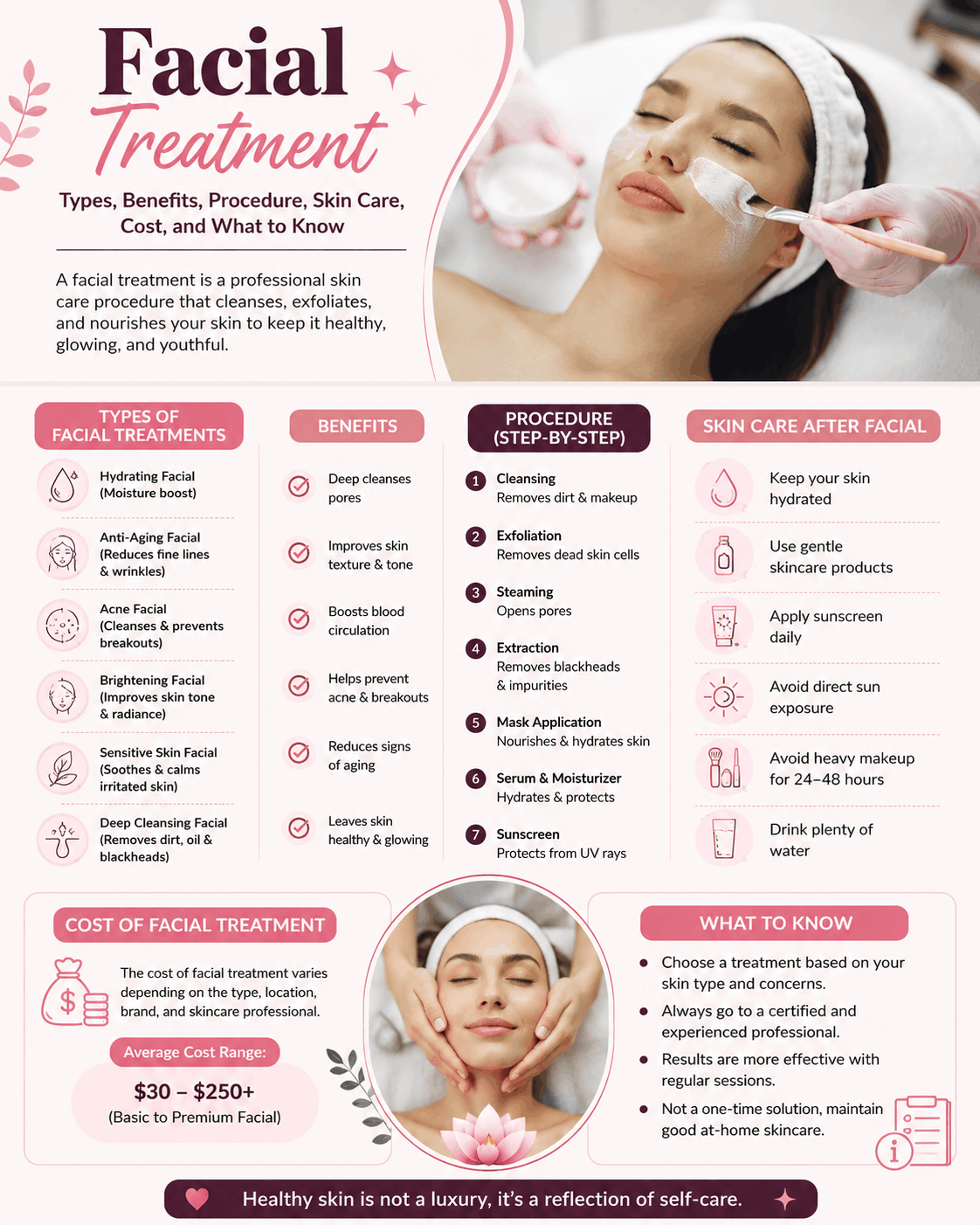
Introduction
Facial treatment is a broad term used for professional or at-home skin-care procedures designed to cleanse, refresh, hydrate, exfoliate, and improve the appearance of the skin. Depending on the treatment, a facial may target concerns such as clogged pores, dryness, dullness, uneven texture, excess oil, pigmentation, or signs of premature aging.
A professional facial is more than simply applying creams to the face. Many treatments combine cleansing, exfoliation, extraction, massage, masks, serums, moisturizers, and sun protection. More advanced facial treatments may use technologies such as chemical exfoliation, microdermabrasion, LED light, or other skin-focused procedures.
The right facial depends on your skin type, current skin concerns, sensitivity, age, and treatment goals. A facial that works well for oily or congested skin may not be ideal for someone with very dry or sensitive skin.
This guide explains the major types of facial treatments, their benefits, what happens during a facial, how often you may need one, possible side effects, aftercare, and how to choose a suitable treatment.
What Is a Facial Treatment?
A facial treatment is a skin-care procedure performed to cleanse and condition the skin of the face.
A basic professional facial may include:
- Skin cleansing
- Exfoliation
- Steam or another method of softening the skin
- Pore cleansing
- Extraction when appropriate
- Facial massage
- Treatment mask
- Serum
- Moisturizer
- Sunscreen
Not every facial includes every step. The procedure varies depending on the type of facial, the provider, and the condition of your skin.
Some treatments are primarily focused on hydration and relaxation, while others are designed to address specific concerns such as acne, hyperpigmentation, or uneven texture.
Benefits of Facial Treatment
Facials can provide several cosmetic and skin-care benefits when appropriately selected.
1. Deep Cleansing
Daily cleansing removes surface impurities, but professional treatments can provide more thorough cleansing and exfoliation.
This may help remove accumulated oil, dead skin cells, and debris from the skin’s surface.
2. Exfoliation
Exfoliation removes dead skin cells from the outermost layer of the skin.
Depending on the facial, exfoliation may involve:
- Gentle scrubs
- Enzyme treatments
- Chemical exfoliants
- Microdermabrasion
- Other professional techniques
The intensity should be matched to the person’s skin type and sensitivity.
3. Hydration
Hydrating facials can temporarily improve the appearance of dry or dehydrated skin.
Ingredients such as hyaluronic acid, glycerin, ceramides, and other moisturizing agents may be incorporated into treatment products.
Well-hydrated skin can look smoother, softer, and more comfortable.
4. Improved Skin Texture
Regular, appropriately selected exfoliation may help create a smoother-looking skin surface.
Professional treatments can be particularly useful when rough texture is related to accumulated dead skin cells or mild congestion.
5. Temporary Glow
One of the most noticeable effects after a facial is often a fresher, brighter appearance.
This may result from cleansing, exfoliation, hydration, and temporary changes in the skin’s surface.
However, a facial should not be expected to permanently transform the skin after a single session.
6. Relaxation
Many traditional facials include massage and a relaxing treatment environment.
For some people, the relaxation aspect is an important part of the experience.
Types of Facial Treatments
There is no single “best facial” for everyone. Different treatments are designed for different needs.
Classic Facial
A classic facial generally combines cleansing, exfoliation, optional extraction, massage, a mask, moisturizer, and other skin-care products.
It can be a good general-purpose option for people who want routine skin maintenance.
Hydrating Facial
A hydrating facial focuses on replenishing moisture and improving the appearance of dry or dehydrated skin.
It may include moisturizing serums, masks, and barrier-supporting products.
People with very sensitive or compromised skin barriers may need a particularly gentle approach.
Deep-Cleansing Facial
A deep-cleansing facial focuses on removing excess oil, surface buildup, and congestion.
It may include exfoliation and extractions.
However, aggressive extraction is not necessarily better. Excessive squeezing or manipulation can irritate the skin and potentially increase the risk of inflammation or marks.
Acne Facial
An acne-focused facial may be designed for people with mild congestion, blackheads, or certain types of acne.
Depending on the person’s skin, treatment may include gentle cleansing, exfoliation, carefully selected ingredients, and limited extraction.
Active inflammatory acne requires appropriate medical management when significant. A cosmetic facial should not replace treatment from a dermatologist when acne is persistent, painful, scarring, or severe.
Anti-Aging Facial
Anti-aging facials commonly focus on hydration, exfoliation, antioxidants, and improving the appearance of fine lines and dullness.
Some advanced treatments may incorporate professional procedures or devices.
Results depend on the treatment and individual skin characteristics.
Brightening Facial
Brightening treatments are designed to improve the appearance of dull or uneven-looking skin.
They may incorporate ingredients such as vitamin C, niacinamide, alpha hydroxy acids, or other brightening agents.
People with pigmentation concerns should be cautious about aggressive treatments because irritation can sometimes worsen discoloration.
Chemical Peel
A chemical peel uses a chemical solution to exfoliate controlled layers of the skin.
Different types and strengths are available.
Chemical peels can be used for concerns such as uneven texture, certain pigmentation problems, and some forms of acne-related skin changes.
Because stronger peels can cause significant irritation and complications when incorrectly used, professional assessment is important.
Microdermabrasion
Microdermabrasion is a mechanical exfoliation technique that removes superficial dead skin cells.
It may temporarily improve the appearance of rough texture and dullness.
It is not suitable for every skin condition, particularly when the skin is inflamed or irritated.
LED Facial
LED treatments use specific wavelengths of light as part of a skin-care procedure.
Different wavelengths are used for different cosmetic goals. Some professional LED treatments are used as an adjunct in acne management and other skin-care routines.
Treatment quality and results can vary depending on the device and protocol.
Hydrafacial-Style Treatment
Hydradermabrasion or Hydrafacial-style treatments generally combine cleansing, exfoliation, extraction, and infusion of moisturizing or skin-care solutions.
They are often marketed as treatments for smoother, hydrated, brighter-looking skin.
The exact process and products vary between providers.
Facial Treatment for Different Skin Types
Choosing a facial based on your skin type can reduce the risk of irritation.
Facial for Oily Skin
Oily skin may benefit from:
- Gentle cleansing
- Controlled exfoliation
- Non-comedogenic hydration
- Careful treatment of clogged pores
- Appropriate acne-focused ingredients
Very aggressive scrubbing can irritate oily skin and may make the skin feel worse.
Facial for Dry Skin
Dry skin generally benefits from treatments focused on hydration and barrier support.
Avoid excessive exfoliation if your skin is already dry, peeling, burning, or irritated.
Facial for Sensitive Skin
Sensitive skin requires a gentle approach.
Fragrance, harsh scrubs, strong acids, excessive heat, and aggressive extraction may trigger irritation in some people.
Always tell the provider if your skin reacts easily to products or procedures.
Facial for Combination Skin
Combination skin has both oily and dry areas.
A customized treatment can address different areas differently rather than applying the same intensive treatment across the entire face.
Facial Treatment for Acne
Acne is one of the most common reasons people seek facial treatments.
A facial may help with surface congestion and provide temporary improvement in the appearance of the skin, but it does not necessarily treat the underlying causes of acne.
Acne can involve:
- Excess oil production
- Blocked hair follicles
- Inflammation
- Bacteria within follicles
- Hormonal influences
For persistent acne, professional dermatological treatment may include topical medications, oral medicines, hormonal treatment, or other evidence-based options depending on the condition.
Avoid having active, painful pimples aggressively extracted.
Facial Treatment for Dark Spots
Facials are sometimes promoted for reducing dark spots and hyperpigmentation.
Some professional treatments may improve uneven pigmentation, but the approach needs to be carefully selected.
Sun exposure can worsen pigmentation, making daily broad-spectrum sunscreen an important part of any pigmentation-focused skin-care routine.
Aggressive procedures can cause irritation, and irritation may sometimes lead to post-inflammatory hyperpigmentation, particularly in people whose skin is prone to discoloration.
Facial Treatment for Glowing Skin
If your primary goal is a temporary glow, a gentle facial combining cleansing, mild exfoliation, hydration, and moisturization may be appropriate.
The visible improvement often comes from removing surface buildup and improving hydration.
For long-term skin health, however, daily skin care is more important than occasional facials.
A basic routine can include:
- Gentle cleanser
- Suitable moisturizer
- Broad-spectrum sunscreen
- Targeted treatment products when necessary
What Happens During a Facial?
The exact process depends on the treatment, but a typical professional facial may follow several steps.
Step 1: Skin Assessment
The provider examines your skin and asks about your concerns, sensitivities, allergies, medications, and current products.
Step 2: Cleansing
The skin is gently cleansed to remove makeup, sunscreen, oil, and surface debris.
Step 3: Exfoliation
An exfoliating product or technique may be used to remove dead skin cells.
Step 4: Extraction
If appropriate, the provider may perform controlled extraction of certain clogged pores.
Not everyone needs extraction.
Step 5: Treatment
A mask, serum, peel, LED device, or another treatment may be selected according to your skin’s needs.
Step 6: Moisturization
A suitable moisturizer is applied to support hydration.
Step 7: Sun Protection
If the treatment is performed during the day, sunscreen should generally be applied before leaving the clinic or salon.
How Long Does a Facial Take?
A basic facial may take approximately 30 to 90 minutes, depending on the treatment and provider.
More advanced procedures can take longer or require multiple sessions.
The duration should not be used as a measure of treatment quality. A longer facial is not necessarily better.
How Often Should You Get a Facial?
There is no universal schedule.
Some people may choose a professional facial every four to six weeks, while others may only have one before an event or when their skin needs extra care.
The appropriate frequency depends on:
- Skin type
- Treatment intensity
- Skin concerns
- Sensitivity
- Existing skin conditions
- Professional recommendations
Over-exfoliating or repeatedly irritating the skin can damage the skin barrier.
Facial Treatment Before a Wedding or Event
A facial may be tempting before an important event, but timing matters.
A gentle treatment may provide a temporary fresh appearance.
However, trying a completely new or aggressive treatment immediately before a wedding or major event can be risky because unexpected redness, swelling, irritation, breakouts, or pigmentation may occur.
If you want a facial before an event, consider using a treatment your skin has already tolerated rather than experimenting with something new at the last minute.
Facial Aftercare
After a facial, your skin may be temporarily more sensitive.
Depending on the treatment, aftercare may include:
- Using a gentle cleanser
- Applying moisturizer
- Wearing sunscreen
- Avoiding unnecessary touching
- Avoiding harsh exfoliants for a short period
- Avoiding irritating active ingredients when advised
- Following the provider’s specific instructions
After stronger treatments such as chemical peels, follow the exact aftercare plan provided by your healthcare professional.
Possible Side Effects of Facial Treatments
Most appropriately performed gentle facials are well tolerated, but side effects can occur.
Possible reactions include:
- Temporary redness
- Mild irritation
- Dryness
- Sensitivity
- Swelling
- Breakouts
- Burning or stinging
- Skin peeling
More aggressive procedures may carry greater risks.
If you develop severe swelling, blistering, intense pain, infection-like symptoms, or a significant allergic reaction, seek medical attention.
Who Should Avoid a Facial?
A facial may not be appropriate during certain skin conditions or situations.
Professional advice is particularly important if you have:
- Active skin infections
- Open wounds
- Severe inflammatory acne
- Significant eczema or dermatitis
- Severe skin irritation
- Recent aggressive cosmetic procedures
- Known allergies to treatment ingredients
People taking certain medications that affect the skin may also need special precautions.
Always disclose your current medications and skin treatments to the provider.
How to Choose the Right Facial Treatment
Choosing a facial based only on popularity is not the best approach.
Consider your primary concern first.
For Dryness
Choose a gentle hydrating treatment.
For Mild Congestion
A controlled cleansing and extraction-focused facial may help.
For Dull Skin
A suitable exfoliating facial may improve temporary brightness.
For Acne
Consider whether a dermatologist should evaluate the acne before having cosmetic treatment.
For Pigmentation
Look for a treatment plan designed specifically for your pigmentation type and skin tone.
For Sensitive Skin
Choose minimal-irritation products and avoid unnecessarily aggressive procedures.
Professional Facial vs. At-Home Facial
Both have their place.
Professional Facial
Advantages may include:
- Professional skin assessment
- Access to specialized equipment
- Controlled exfoliation
- Professional extraction
- Customized treatment
However, quality varies considerably between providers.
At-Home Facial
At-home skin care is convenient and usually less expensive.
A simple routine involving cleansing, moisturizing, and sunscreen can provide important long-term benefits.
Home users should be cautious about strong acids, aggressive exfoliation, extraction tools, and other procedures that can injure the skin when used incorrectly.
How Much Does Facial Treatment Cost?
The cost of facial treatment varies widely depending on the type of facial, location, provider, products, equipment, and number of sessions.
A basic facial is generally less expensive than advanced procedures such as chemical peels, professional laser treatments, or device-based treatments.
Before booking, ask what is included in the price and whether additional products or follow-up sessions are recommended.
Facial Treatment and Sunscreen
Sunscreen is one of the most important parts of maintaining the results of many facial treatments.
UV exposure contributes to premature skin aging and can worsen pigmentation.
A broad-spectrum sunscreen with an appropriate SPF should be used regularly, especially after treatments that increase sensitivity to sunlight.
Follow the specific sun-avoidance instructions provided after chemical peels or other professional procedures.
Is Facial Treatment Worth It?
For many people, a facial can be a useful addition to a broader skin-care routine.
However, it should not be viewed as a replacement for basic daily skin care or medical treatment.
The biggest benefits may come from:
- Professional assessment
- Controlled exfoliation
- Temporary hydration
- Improved surface texture
- Relaxation
- Customized skin care
People with medical skin conditions may benefit more from seeing a dermatologist than repeatedly booking cosmetic facials.
Common Facial Treatment Mistakes
Over-Exfoliating
Using multiple exfoliating products or procedures too frequently can weaken the skin barrier.
Aggressive Extraction
Squeezing pores aggressively can cause inflammation and potentially leave marks.
Ignoring Sunscreen
UV exposure can undermine efforts to improve pigmentation and signs of aging.
Trying New Treatments Before an Event
A new treatment can cause an unexpected reaction.
Choosing Based Only on Price
The cheapest treatment is not always the safest or most suitable.
Ignoring Skin Conditions
A cosmetic facial may not be appropriate for active dermatitis, infections, or severe acne.
Final Thoughts
Facial treatment can be a helpful way to cleanse, exfoliate, hydrate, and temporarily improve the appearance of the skin. From classic and hydrating facials to acne-focused treatments, chemical peels, microdermabrasion, LED procedures, and other advanced options, there are many choices available.
The most important factor is not choosing the trendiest facial but selecting a treatment that matches your skin type, concerns, sensitivity, and overall skin health.
A gentle facial may be appropriate for routine maintenance, while persistent acne, significant pigmentation, severe sensitivity, scarring, or other skin problems may require professional dermatological assessment.
Good results also depend on what happens between appointments. Gentle cleansing, appropriate moisturization, consistent sunscreen use, adequate hydration, and a simple skin-care routine can support healthier-looking skin far more effectively than relying on occasional treatments alone.
Before undergoing an intensive facial or cosmetic procedure, make sure you understand the expected benefits, possible side effects, aftercare, and whether the provider is appropriately qualified. When treatment is customized to your skin rather than chosen simply because it is popular, the experience is more likely to be both safe and worthwhile.
FAQs About Facial Treatment
1. What is a facial treatment?
A facial treatment is a professional or at-home skin-care procedure designed to cleanse, exfoliate, hydrate, and improve the appearance of facial skin. The exact steps depend on the type of facial.
2. What are the benefits of a facial?
Potential benefits include deep cleansing, exfoliation, temporary hydration, smoother-looking texture, improved radiance, and relaxation. Results depend on the treatment and individual skin.
3. How often should I get a facial?
There is no fixed schedule for everyone. Some people choose a facial every four to six weeks, while others have them less frequently. Treatment intensity and skin sensitivity should be considered.
4. Which facial is best for dry skin?
A gentle hydrating facial is generally more appropriate for dry skin than an aggressive exfoliating treatment. Products that support the skin barrier may also be beneficial.
5. Can facials help acne?
Some facials may help with mild congestion and blackheads, but they do not replace medical acne treatment. Severe, painful, persistent, or scarring acne should be evaluated by a dermatologist.
6. Can a facial remove dark spots?
Some professional treatments may improve the appearance of certain types of pigmentation, but results vary. Sun protection is essential, and aggressive treatments can sometimes worsen pigmentation through irritation.
7. Is facial treatment safe for sensitive skin?
It can be, provided the treatment is appropriately customized. Sensitive skin may require gentle products and minimal exfoliation. Tell your provider about any known sensitivities before treatment.
8. Can I wear makeup after a facial?
It depends on the type of facial. After a gentle treatment, makeup may be tolerated, while stronger procedures may require avoiding makeup for a specific period. Follow the aftercare instructions given by your provider.
9. Should I get a facial before a wedding?
A gentle, familiar facial may provide a temporary refreshed appearance. Avoid experimenting with an aggressive or completely new treatment immediately before an important event because irritation or other reactions can occur.
10. Is a professional facial better than an at-home facial?
Professional facials can offer customized assessment, specialized equipment, and controlled procedures, while at-home skin care is convenient for regular maintenance. The best choice depends on your skin needs and treatment goals.