Nail Fungus: Causes, Treatment, Prevention, and Recovery
Introduction
Nail fungus, also known as onychomycosis, is a common infection that causes changes to the nail’s appearance. The nail fungus may begin as a small spot of discoloration but eventually lead to thickening, brittleness, debris buildup, and nail separation. Onychomycosis is much more common on the toenails than the fingernails.
Nail fungus is rarely an emergency but can be a slow-to-treat condition. Unlike a superficial infection, the fungus can live deep within the nail and the tissue underneath, so simply removing the infected portion of the nail is usually not enough to get rid of the infection.
Nail fungus can also be recurrent, especially if a person’s feet are often exposed to warm, moist environments or if they have athlete’s feet. The infection can typically be cleared with an appropriate antifungal treatment, however. This article discusses the appearance of nail fungus, its causes, treatments, prevention methods, and when to see a dermatologist.
What Is Nail Fungus?
Nail fungus is an infection caused by fungi that invade the nail or the tissue underneath it. The medical name for this condition is onychomycosis.
The infection can affect:
• One toenail
Several toenails
• One or more fingernails
• The fingernails and toenails simultaneously
The infection is more common on the toes since shoes create a warm, moist environment that is conducive to the growth of fungi.
What Does Nail Fungus Look Like?
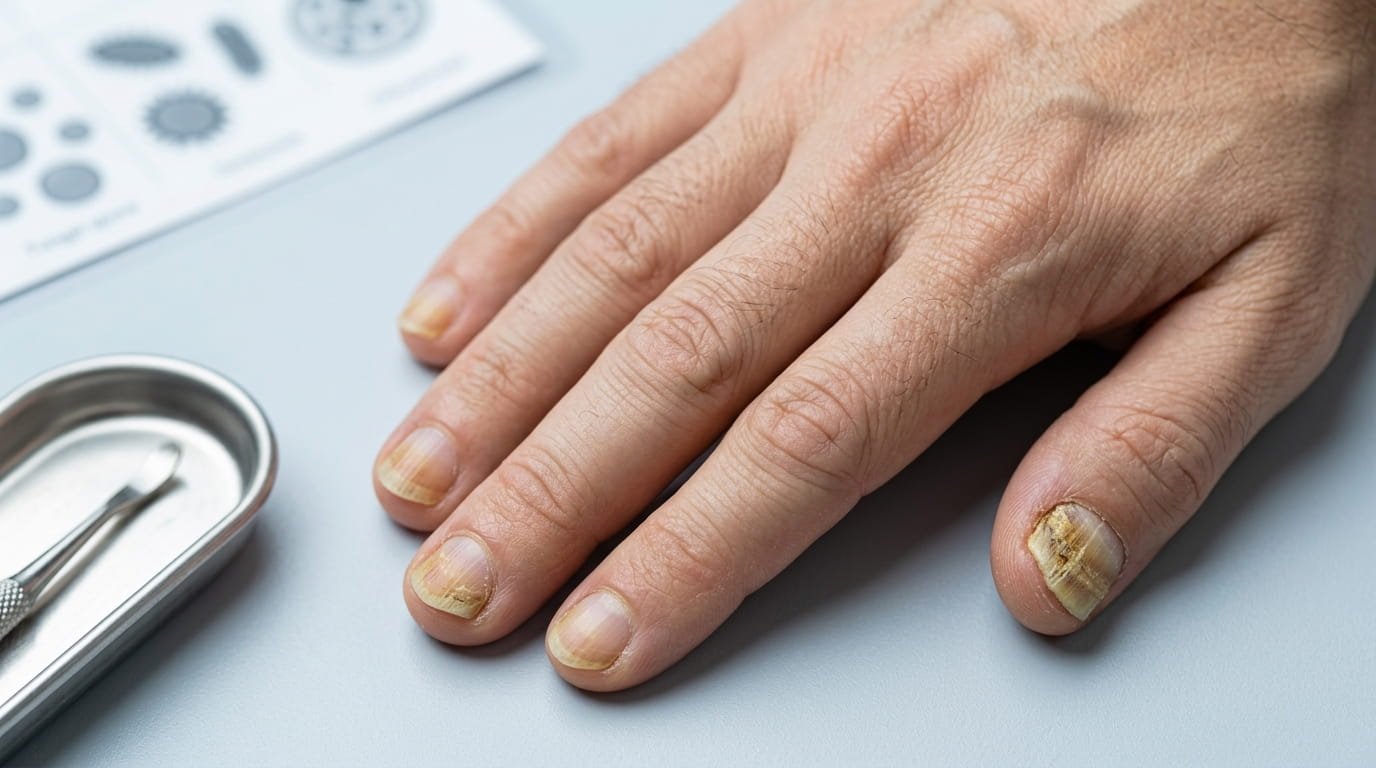
The appearance of nail fungus can vary depending on the type and severity of the infection. Some of the most common signs and symptoms include:
Yellow, white, brown, or other unusual discoloration of the nail
• Thickened nails
Brittle or crumbly nails
• Splitting or cracking of the nail
Debris buildup underneath the nail
• Nail separation
Changes in the shape of the nail
• Rough or powdery texture of the nail
Loss of the nail
• Painful nail (in severe cases)
Discoloration is usually one of the first signs of the infection, although it may not always be present. It is also common for a thickened, discolored, or crumbly nail to be the result of another condition, such as an injury.
Nail Fungus Symptoms
1. Discolored Nail
The infected nail may begin to change color to yellow, white, brown, or another unusual color. The color change often starts at the tip of the nail and progresses toward the cuticle.
2. Thickened Nail
As the infection progresses, the infected nail may become notably thicker than the other nails.
3. Brittle or Crumbly Nail
The nail fungus may cause the nail to become brittle or crumbly. This symptom is common in people with severe infections.
4. Nail Separation
The nail may start to separate from the nail bed. This condition is also known as onycholysis.
5. Debris Buildup
A common sign of nail fungus is the presence of debris underneath the nail.
6. Changes In The Shape Of The Nail
The shape of the infected nail may start to change as the infection progresses.
7. Painful Nail
Nail fungus is typically not painful, especially in the early stages. However, severe infections can cause pain and discomfort, especially if the nail becomes thick and starts to put pressure on the toe.
What Causes Nail Fungus?
There are several types of fungi that can cause onychomycosis. These organisms typically thrive in warm, moist environments.
A person can get nail fungus when the fungi enter the nail through a small opening. The infection can also be contracted from another person who has the infection or from contaminated objects.
Some of the most common sources of infection include:
Infected nails or skin
• Shared nail clippers
• Shared towels
Public showers
• Locker rooms
Swimming pool decks
• Warm, moist socks
• Warm, moist environments
A person can also get a fungal infection if the skin around the nail is injured.
Is Nail Fungus Contagious?
Yes, nail fungus can be contagious. The infection can be transmitted from one person to another and can also be contracted from contaminated objects.
Who Is More Likely to Get Nail Fungus?
Anyone can get nail fungus, but some people are at a higher risk than others. The risk factors for onychomycosis include:
• Advanced age
Frequently being in warm, moist environments
• Having sweaty feet
• Wearing tight shoes
Having a history of nail fungus
Having an injury to the nail
• Having athlete’s foot
Having psoriasis
Having excessive sweating
• Having diabetes
Having poor circulation
• Having peripheral artery disease
Having other conditions
• Having a family history of nail fungus
People who often visit public places such as gyms, swimming pools, locker rooms, and showers are also more likely to get nail fungus.
Nail Fungus vs. Other Nail Conditions
Nail fungus is not the only condition that can cause thickened, discolored, or deformed nails. For this reason, it is important to receive a proper diagnosis to ensure that an appropriate treatment is selected.
Nail trauma, psoriasis, and other conditions can also cause similar symptoms. This is why a dermatologist may perform a biopsy to confirm the diagnosis before recommending an antifungal treatment.
How Is Nail Fungus Diagnosed?
A dermatologist can typically diagnose nail fungus based on the appearance of the nail. During the examination, the doctor will look for the following common signs and symptoms of onychomycosis:
• Discolored nail
• Thickened nail
Debris under the nail
• Separated nail
• Changes to several nails
Signs of athlete’s foot or other fungal infections
In some cases, the dermatologist may need to perform additional tests to confirm the diagnosis. The doctor may take a sample of the debris or nail tissue for testing.
This step is particularly important because it can take several weeks or months for the infection to clear, and different conditions require different treatments.
Nail Fungus Treatment
The treatment for onychomycosis depends on the severity of the infection, the number of affected nails, the type of fungus, the patient’s health, and other factors. The most common treatment options for nail fungus include topical antifungal treatments, oral antifungal medications, and other procedures.
Topical Antifungal Treatments for Nail Fungus
Topical treatments are applied directly to the affected nail. These treatments are typically recommended for mild cases or certain types of infections. The most common topical treatments for nail fungus include:
• Efinaconazole
Tavaborole
• Ciclopirox
The medication must typically be applied to the affected nail every day for a certain period of time. For example, the American Academy of Dermatology (AAD) recommends applying efinaconazole or tavaborole once a day for approximately 48 weeks in the case of toenail fungus.
It is important to continue using the medication even if the nail begins to look better because stopping the treatment prematurely can cause the infection to return.
Oral Antifungal Treatment for Nail Fungus
A dermatologist may recommend an oral antifungal medication for a severe infection or for multiple affected nails. Terbinafine is a common prescription medication that can be used to treat fingernail and toenail fungus infections in adults.
According to the AAD, this medication typically needs to be taken for about 6 weeks for fingernail infections and 12 weeks for toenail infections, although the treatment plan may vary depending on the patient’s case. The liver function should also be regularly monitored since the medication can cause rare side effects such as liver damage.
Another oral medication that can be used to treat fungal infections of the fingernails and toenails is itraconazole. This drug has several contraindications and should only be used when the benefits outweigh the potential risks.
Why Does The Nail Still Look Bad After Treatment?
This is an important question since many people are surprised to see that their infected nail does not return to its previous appearance even after the infection has cleared. The good news is that most people do not need to worry because the improvement of the nail is typically a slow process.
The infection may have been successfully treated, but the damaged portion of the nail has to grow out before it can be replaced with a healthy one. Since toenails typically take a long time to grow, a person may need to wait for up to a year or even longer before seeing a noticeable improvement.
Can Over-The-Counter Terbinafine Cream Treat Nail Fungus?
The over-the-counter (OTC) terbinafine cream is indicated for the treatment of fungal infections of the skin, such as athlete’s foot and jock itch. This medication is not effective against nail fungus, however, because it is not potent enough to penetrate the nail plate. The AAD explicitly warns that topical terbinafine treatments are not suitable for treating fungal infections of the nails.
Can Nail Fungus Be Treated With Home Remedies?
There are a variety of home remedies that can be used to treat nail fungus. For example, some people apply tea tree oil, mentholated creams, vinegar, essential oils, and other substances to their infected nails in an attempt to get rid of the infection.
The effectiveness of these treatments is not supported by substantial evidence, but some studies suggest that tea tree oil and mentholated treatments may have certain benefits. The AAD notes that the evidence is limited, and more research is needed before these treatments can be officially recommended.
Can You File Away Nail Fungus?
It is a common misconception that nail fungus can be easily removed by filing the infected portion of the nail. In reality, filing only removes some of the superficial debris, but the infection remains underneath the nail.
A dermatologist can file the infected portion of the nail during a procedure known as debridement. The doctor can also trim the nail to make it easier for topical treatments to penetrate the nail plate and reach the infection.
Are Laser Treatments Effective For Nail Fungus?
Laser treatment for nail fungus is an innovative procedure that is often promoted as a safe and effective way to get rid of the infection. However, it is important to understand that lasers are only used for cosmetic reasons and that this procedure is not an approved treatment for onychomycosis.
The AAD warns that lasers have not been approved by the Food and Drug Administration (FDA) to treat fungal infections. Some lasers can be used to improve the appearance of the nail after the infection has cleared, while researchers continue to study whether light therapy can safely and effectively remove the infection.
Can Nail Fungus Go Away On Its Own?
Nail fungus rarely clears on its own, especially since the infection can live underneath the nail. The infection can also spread to other nails if it is left untreated. The AAD warns that nail fungus almost never goes away without treatment.
On the other hand, early treatment can significantly improve the patient’s prognosis since the infection is typically easier to remove when it is still small and localized.
How Long Does It Take To Treat Nail Fungus?
The duration of treatment depends on the severity of the infection, the number of affected nails, and the type of treatment. Topical treatments may need to be used for several months, whereas oral treatments typically last for several weeks.
It is also important to note that the length of treatment and the healing period are two different things. The infection may be successfully treated, but it can take several months or even a year for the infected nail to grow out and be replaced with a healthy one.
Nail Fungus Prevention
Preventing recurrent infections is an essential part of managing onychomycosis.
Keeping Your Feet Clean and Dry
It is important to keep the feet clean and dry to prevent the growth of fungi. The AAD recommends washing and thoroughly drying the feet, especially between the toes.
Wearing Clean Socks
Wearing clean socks on a daily basis can also reduce the risk of nail fungus. It is also a good idea to switch to a new pair of socks if the feet start to feel sweaty.
Wearing Socks Made of Breathable Materials
Socks made of breathable materials can help keep the feet dry. It is also a good idea to allow the shoes to air out after wearing them, if possible. The AAD recommends waiting for at least 24 hours before wearing the same pair of shoes again.
Wearing Footwear in Public Showers, Locker Rooms, And Gyms
Wearing sandals, flip-flops, or other forms of footwear in public places such as showers, locker rooms, and gyms can significantly reduce the risk of nail fungus. These environments can expose the feet to fungi and other pathogens.
Avoiding Sharing Personal Items
It is important to avoid sharing personal items with other people. This includes nail clippers, files, towels, socks, and shoes. If a person has nail fungus, they should also make sure that their personal items are not shared with others.
Keeping Your Nails Trimmed
Keeping the nails short can reduce the risk of nail fungus since long nails are more likely to accumulate fungi and other foreign substances. Toenails should be trimmed straight across rather than at an angle.
Treating Athlete’s Foot
Athlete’s foot, or tinea pedis, is a fungal infection that can affect the skin on the feet. The infection can also affect the toenails, especially if it is left untreated.
Can Nail Fungus Be Prevented?
Yes, nail fungus can often be prevented with the right measures. The infection can be prevented by keeping the feet clean and dry, wearing clean and breathable socks, avoiding walking barefoot in public places, avoiding sharing personal items, and treating athlete’s feet.
Can Nail Fungus Come Back?
Yes, nail fungus can be recurrent, especially if a person’s feet are often exposed to warm and moist environments. The infection can also be contracted from infected nails, skin, or personal items.
People who have already had nail fungus may need to be extra careful to avoid getting the infection again. In some cases, a dermatologist may also recommend a maintenance treatment to reduce the risk of recurrence.
When Should You See a Dermatologist for Nail Fungus?
A person should see a dermatologist if their nail becomes yellow, brown, white, or unusually dark, thickens or becomes brittle, separates from the nail bed, or if several nails are affected. A dermatologist should also be contacted if the infection does not respond to OTC treatments, causes significant pain, causes the nail to change shape, or if the person has diabetes or poor circulation.
Nail fungus can be a sign of another medical condition, so it is important to consult a dermatologist to rule out other causes. People with diabetes or poor circulation may need to seek medical advice even if their nail fungus symptoms are mild.
Conclusion
Nail fungus can be a common, persistent infection that often starts as a small spot of discoloration on the nail. It can eventually lead to thickening, brittleness, debris buildup, nail separation, and changes in the shape of the nail.
One of the most important steps in managing onychomycosis is receiving an accurate diagnosis. Nail psoriasis, nail trauma, and other conditions can cause similar symptoms, so a dermatologist may need to perform a biopsy to confirm the diagnosis.
After a diagnosis is confirmed, the patient can begin an appropriate treatment to get rid of the infection and restore the appearance of the nail. The most common treatment options for nail fungus include topical and oral antifungal treatments. Some procedures can also be used to remove the infected portion of the nail, especially if the infection is severe.
It is also important to remember that treating the infection and improving the appearance of the nail are two different processes. Even after the infection has cleared, a person may need to wait for up to a year or longer before seeing a noticeable improvement if they had a toenail infection.
Prevention is another critical part of managing nail fungus. Keeping the feet clean and dry, wearing breathable shoes, avoiding walking barefoot in public places, avoiding sharing personal items, and treating athlete’s feet are some of the most effective ways of preventing infection.
If a person notices that their nail is discolored, thickened, crumbling, or separating from the nail bed, they should not try to ignore these symptoms. Seeing a dermatologist can help them determine the cause of the changes to their nail and put them on the right path to healthier-looking nails.
Frequently Asked Questions(FAQs)
1. What is nail fungus?
Nail fungus, or onychomycosis, is a fungal infection that affects the nail or the tissue underneath it.
2. Is nail fungus contagious?
Yes, nail fungus can be contagious. The infection can be transmitted from one person to another and can also be contracted from contaminated objects.
3. What is the fastest treatment for nail fungus?
There is no single, fastest treatment for nail fungus since the most appropriate course of action depends on several factors.
4. Can I use terbinafine cream for toenail fungus?
Terbinafine cream is indicated for the treatment of fungal infections of the skin, such as athlete’s foot and jock itch.
5. Can nail fungus be cured permanently?
Nail fungus can be successfully treated, but it can also be recurrent.
6. Does nail fungus hurt?
Nail fungus is typically not painful, especially in the early stages of the infection.
7. Can I remove nail fungus by filing my nail?
Filing does not remove the infection since the fungus can live underneath the nail. A person may need to see a dermatologist to have the infected portion of the nail removed.
8. How long does it take to clear toenail fungus?
The infection may be successfully treated within a few weeks or months,
9. Can nail fungus spread to other nails?
Yes, nail fungus can spread to other nails if it is not treated. The infection can also be contracted from the athlete’s foot.
10. When should I see a dermatologist for nail fungus?
A person should see a dermatologist if their nail becomes discolored, thickened, crumbly, or separated.
Nail fungus, also known as onychomycosis, is a common infection that causes changes to the nail’s appearance.